

Search Website
Microteaching Programs
Microteaching Programs: Take One or Take All!
Overview
While any graduate student or postdoctoral scholar can take any or all of our microteaching programs, successful completion of one of these blended programs is required in order to complete the Western Certificate in University Teaching and Learning (WCUTL).
Each microteaching program includes asynchronous online preparation work and 2 – 3 days of in-person or online synchronous learning as a cohort, as well as the opportunity to prepare and deliver two 10-minute microteaching lessons and to give and receive feedback with a small group of peers.
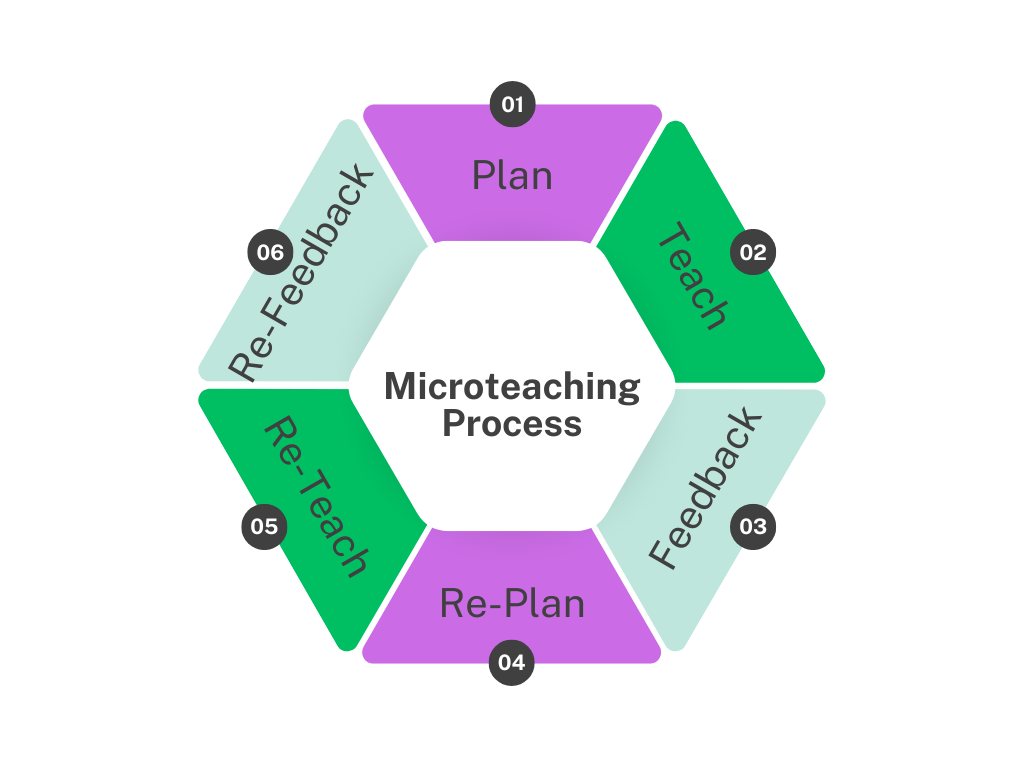
Microteaching is a teaching technique often used for pedagogical development. In a microteaching session, an educator delivers a short, focused lesson (at CTL, 10 minutes) for a small group of learners in order to practice, demonstrate, and refine their approaches. Each educator in a group of learners has the opportunity to teach, as well as give and receive feedback.
These programs also take a “flipped classroom” approach, in which learning content and materials are provided as asynchronous work, and time together as a cohort is reserved for active learning opportunities, microteaching and feedback, generative discussion, and deeper exploration of the material.
Image 1. Microteaching Process. From Planning and Curriculum by Giang-Nguyen Nguyen. Licensed under a Creative Commons 4.0 License.
Suggested Audiences by Program
Please note that these programs can (but do not have to be) taken sequentially. You are welcome to sign up for one or all these programs, in any order, as you prefer or need:
- TA Training Program (TATP)
Ideal for graduate students who: 1) are new to Western University; 2) are new to the teaching assistant (TA) role; 3) are experienced educators who want to refresh foundational teaching skills for a TA role. - Teaching in the Canadian Classroom (TCC)
Ideal for graduate students and postdoctoral scholars who: 1) are seeking a sociocultural exploration of teaching in Canadian contexts; 2) would like to explore intercultural approaches to teaching and learning; 3) are new to Canada; 4) are first-generation graduate students; 5) are new graduate students or new to Western University - Advanced Teaching Program (ATP)
Ideal for graduate students and postdoctoral scholars who: 1) have taken TATP and/or TCC and would like to explore beyond foundational TA and teaching scholars; 2) hope to take on course instruction and/or faculty roles in the future; 3) would like to explore the Scholarship of Teaching and Learning; 4) have extensive TA experience
TCC runs a minimum of 3 times a year, with sessions in the summer, fall, and winter semesters
ATP runs a minimum of 2 times a year, with 4 half-day in-person sessions sessions in the middle of the fall and winter semesters
Microteaching Program Descriptions
Please note: all of our microteaching programs, with the exception of SGPS 9500, require a $20.00 deposit for enrolment. This deposit is fully refundable upon successful completion of the program, or if the participant withdraws more than 76 hours in advance.
TA Training Program (TATP)
Registration for the September 12/13 cohort is now closed.
TATP is a 20-hour blended program comprised of both asynchronous and synchronous learning that has been designed especially for new TAs embarking on their teaching careers. In this program, participants will explore approaches and strategies, such as fair grading practices; diverse, intercultural classrooms; engaging and accessible classroom participation; and GenAI considerations as a TA. Participants will have the chance to explore real-time, hands-on teaching experiences in our unique microteaching sessions where you can try out your teaching skills with a small group of your peers and receive helpful, constructive feedback. At the end of the program, participants will receive a certificate of completion as evidence of your commitment to the development of your knowledges, mindsets, and skills as a teacher.
By the end of TATP, participants will develop the skills and confidence to
- Design and deliver effective, accessible, and engaging lessons using the Bridge – Outcomes – Pre-Assessment – Participatory Learning – Post-Assessment – Summary (BOPPPS) Model
- Identify (inter)cultural influences on communication in the classroom
- Initiate constructive conversations with instructors and students about the use of GenAI in courses
- Apply the characteristics of effective and fair feedback for peer educators
- Engage in fair grading practices
- Collaborate with other graduate educators through microteaching, peer feedback, and reflection on personal approaches to teaching and learning
- Identify institutional resources available for student and TA academic success
Teaching in the Canadian Classroom (TCC)
Registration for the October 8-10 cohort is now closed.
TCC is a 20-hour blended certificate program comprised of both asynchronous and synchronous learning open to all Western graduate students and postdoctoral scholars who want to enhance their teaching through a sociocultural lens. The program is informed by key questions such as:
- What are some of the characteristics of a Canadian post-secondary classroom?
- How can I design effective lesson plans?
- Which classroom teaching strategies are best suited for my teaching context?
The program’s design and facilitation aims to build on the participants’ skills, expertise, and experience. TCC offers participants opportunities to explore teaching strategies for the intercultural classroom, apply classroom assessment techniques, practice active learning strategies, apply benchmarking techniques, and navigate challenging classroom scenarios working in small groups. Participants will also deliver a microteach lesson and practice both giving and receiving constructive feedback using the CAOS (constructive, actionable, objective/observable, specific) framework.
TCC supports participants in practicing and reflecting on their teaching identity development, while engaging with peers in a supportive atmosphere.
By the end of TCC, participants will gain the skills and confidence to
- Explore the norms, expectations, and dynamics of intercultural classrooms in the Canadian post-secondary context.
- Design and deliver learner-centered lessons using the BOPPPS model and evidence-informed teaching strategies.
- Apply active learning, classroom assessment, and benchmarking techniques to enhance student learning.
- Practice responding to common classroom challenges in ways that support inclusive and effective learning environments.
- Develop their teaching identity through microteaching, reflection, and receiving and giving constructive feedback using the CAOS framework.
Advanced Teaching Program (ATP)
Registration for the Fall October 22nd - Nov 12th Cohort is now closed
ATP is a 20-hour short course designed for graduate students and postdoctoral scholars who would like to develop practical and evidence-based teaching skills for current and future teaching roles. Topics include course design strategies, active learning, authentic assessment of student learning, the Scholarship of Teaching and Learning (SoTL), and building community and collaboration in the classroom. Participants gain hands-on experience by practicing instructional techniques in microteaching sessions where they receive constructive feedback from peers and an experienced team of instructors.
The capstone project for this program is the design and submission of a course outline. The syllabus design project helps participants to integrate key course design ideas including aligned outcomes, assessments and active learning strategies.
Note: The course outline design project also fulfills part of the written submissions requirement of the Western Certificate in University Teaching and Learning. By completing ATP, participants thus fulfill two components of the Certificate.
By the end of ATP, participants will develop the skills and confidence to
- Design effective learning outcomes that align with assessment techniques and teaching and learning strategies at the lesson- and course-level
- Develop and facilitate active learning strategies to increase student engagement
- Assess student learning using formative and summative methods
- Refine and practice teaching skills by giving and receiving peer feedback in a supportive, multi-disciplinary setting
- Engage in self-reflection on values, goals, and key teaching strategies and approaches
SGPS 9500: Theory and Practice of University Teaching
Next anticipated offering: Winter 2027
SGPS 9500 is a graduate level credit course on teaching and learning in higher education. The goals of the course are to deepen your understanding of foundational theory and research relevant to university teaching, and to provide an opportunity for engaging in course design and facilitating student engagement.
The course begins by exploring how to devise and align learning outcomes, assessments, and active learning activities. Then, over the semester, students have the chance to develop and revise a teaching philosophy statement, receive feedback on short teaching presentations, and create a comprehensive course syllabus. In small groups, students will also develop a webpage and seminar presentation on a pedagogical topic of their choice. SGPS 9500 is an interdisciplinary course, meaning that students will engage deeply with educational theory and practice alongside instructors and peers from across academic disciplines.
By the end of the course, learners will develop the skills and confidence to
- Find, cite and critically reflect upon research literature on contemporary issues in university teaching and learning, such as: Principles of effective teaching, the globalization of education, curriculum theory, course design considerations and the forms and functions of assessment
- Develop and facilitate active learning experiences
- Give and receive constructive peer feedback about instruction, in both written and oral formats
- Clearly communicate your teaching philosophy, a written statement guided by your beliefs, values and the disciplinary context in which you teach
- Articulate an evidence-based rationale for lesson and course-design choices.