

Search Website
Backward Course Design
When planning how to teach, especially for newer instructors or when working under strict time constraints, it is tempting to start by building learning materials such as lectures and discussion topics, design assessments around these and then connect these assessments to the learning outcomes for the course.
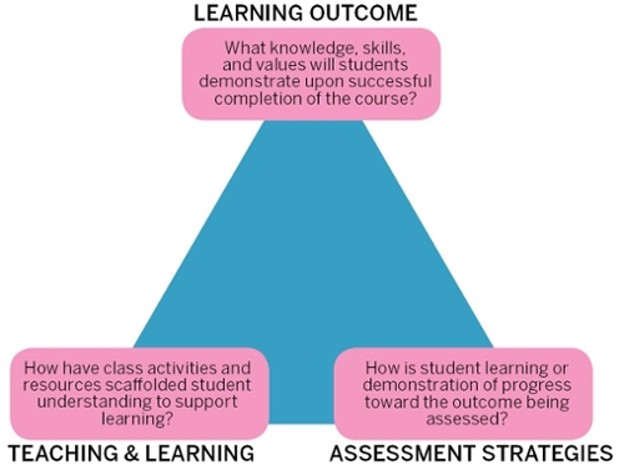
A backwards design approach, however, starts with the learning outcomes. These are what students will know, do, and value as a result of learning in your course. From there, assessments are developed which allow instructors to gauge to what degree students have achieved the learning outcome, and various learning materials are developed to support students in achieving the assessments. Such an approach allows for more intentional teaching and transparency in the teaching and learning process.
We discuss learning outcomes, teaching and learning approaches, and assessment strategies in more detail below.
In designing a cohesive course, you should begin by developing learning outcomes. We offer a brief introduction to this, and more information can be found on our page about learning outcomes. Outcomes state what students will know, do, and value as a result of learning in your course. Learning outcomes should engage students across various levels of Bloom’s taxonomy so as to allow them to demonstrate their knowledge using more sophisticated means.
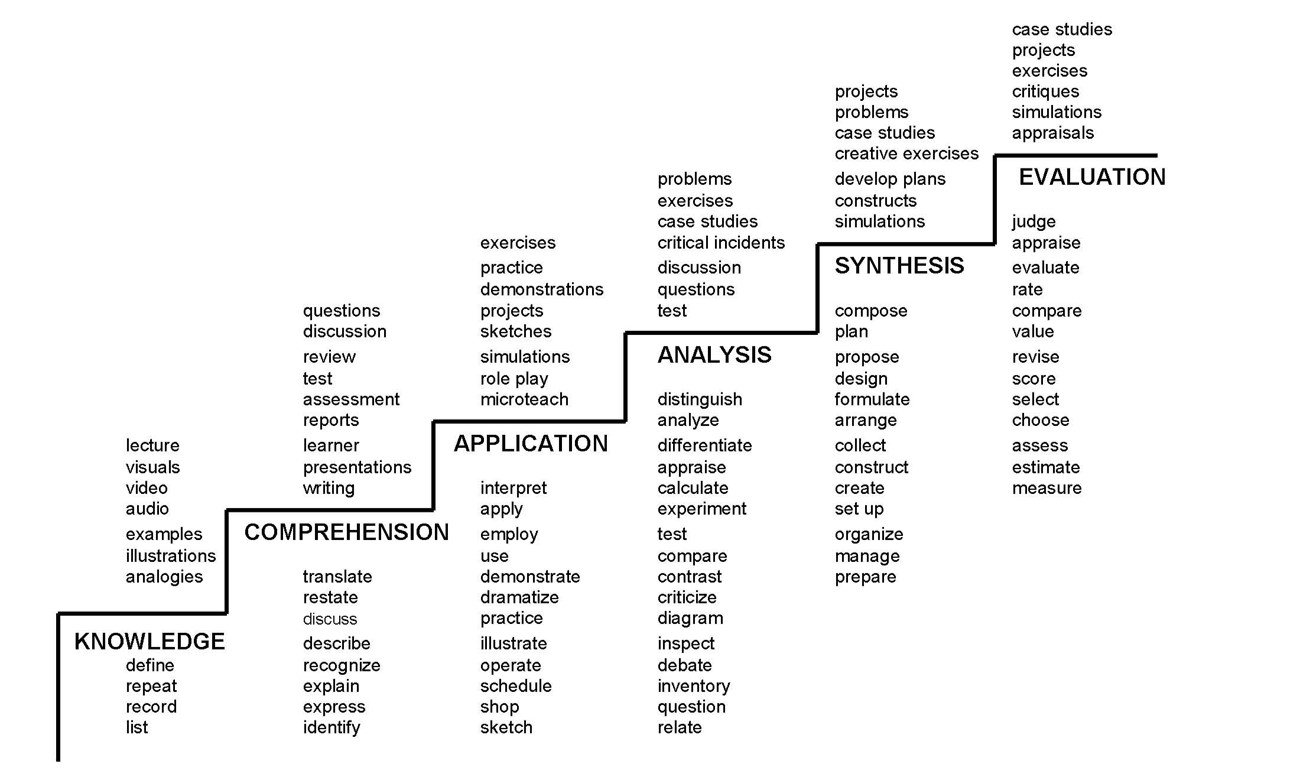
In order to respond to the question, “How will I know if my students have met my outcomes?” instructors must assess students to measure their knowledge. See our page on assessment for more ideas of how you can assess student learning. The assessments must also measure the key course outcomes that address the question, “What is it I want students to know or be able to know, do, or value at the end of this course?” If the outcome has utilized a verb from the higher orders on Bloom’s Taxonomy, then the assessment tool must match the action of the verb. For example, if the course outcome is to redesign and critique a Roman weapon of war, a pencil and paper exam may not truly capture how well a student has achieved this expectation without first having actually constructed the weapon. Only then could students offer ideas for redesign by critiquing what worked or didn’t on the original armament. In choosing active verbs as outcomes, the assessments must make room for student performance to demonstrate what they have learned. This will shape what happens in class time as well as how instructors will scaffold the skills students need to actually complete the assessment tasks.
Scaffolding is based on Vygotsky’s (1978) zone of proximal development and proposes that it’s important to determine the area (zone) between what a student can accomplish unaided and what that same student can accomplish with assistance. For example, if you include an assessment task – say a research poster – that is worth 60% of the final grade, instructors are assuming that students have the skills and background necessary to meet these high expectations. However, the reality is that students may not have had preparation to meet this level of expectation, including opportunities to submit an outline for comment, or preliminary drafts of the poster that they can revise and resubmit. When considering scaffolding for student learning, a good guideline “…is the higher the stakes, the more scaffolding you need to include. In other words, the heavier the weight, the stronger the support.” (Caruana, 2012, para 2).
To get started with scaffolding, create a brief outline of each assessment for the course including the skills needed to be successful on the assignment. List the prerequisite skills that students must possess. Consider if it is reasonable that students have these skills before arriving in your course, or if you need to teach these skills. Next, consider where these skills are naturally introduced in your course, and how they can be folded into assignments. Now, look at the list of assessments that you have assembled for the course and include the appropriate skills for each assignment. Finally, create an outline of how each major assignment is scaffolded to be shared with students so that they understand how the learning opportunities in the course have been designed to work together and build upon each other in a logical way.
Once assessments have been developed and appropriately scaffolded, teaching strategies to support student understanding of the material can be developed. Often, contact time with students is viewed as the opportunity to deliver content through variations on the lecture mode (e.g., instructors teaching, video, guest speakers) which places students as passive collectors of information. Textbooks, articles and other pre-class resources like videos and podcasts are typically used to reinforce the concepts introduced in class time. Importantly, as learning outcomes are higher on Bloom’s Taxonomy, students will need to be more involved in the learning process in order to engage with achieving these outcomes. For example, a traditional lecture does not allow students to design or evaluate during class time. While content delivery from instructor to students is important, considering other ways students may be able to engage in learning is significant. See our page on active learning for ideas on how to engage students in the learning process.
A well-designed course – where the teaching/learning strategies are aligned with course outcomes and assessments – should be communicated with students. This can be done verbally in class, but also in the course outline which can become a learning map for students. Thus, the tone and content of that document must be easily understood and the development process clearly outlined. There are different methods of sharing this alignment with students in the course outline, and we offer two below.
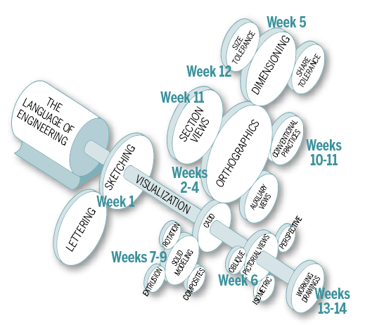
The first is an example of a graphic syllabus for an engineering course where students can see how the topics and Big Ideas relate to each other over the progression of the course.
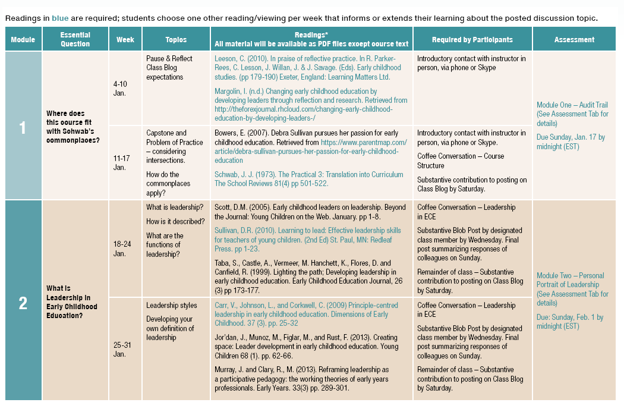
Other instructors find that a Course at a Glance is a helpful organizer for their students. Instead of an illustration, the course is laid out in chart form illustrating the week of the course, the topic or Big Idea, some essential questions that will be explored, the texts that correspond to the discussion, and any assessment that is due.
Biggs, J. (2003). Teaching for quality learning at the university: What the student does. (2nd Ed) SRHE Buckingham, UK: Open University Press.
Bloom, B. S. (1956). Taxonomy of educational objectives: The classification of educational goals. Handbook 1: Cognitive domain. New York, NY: David McKay.
Brookhart, S. (2013). How to create and use rubrics for formative assessment and grading. Alexandria, VA: Association for Supervision and Curriculum Development.
Caruana, V. (2012). Scaffolding student learning: Tips for getting started. Faculty Focus Retrieved from http://www.facultyfocus.com/articles/instructional-design/scaffolding-student-learning-tips-for-getting-started/
Covey, S.R. (1989). The seven habits of highly effective people: Powerful lessons in personal change. New York, NY: Free Press.
Crocker, W. A. (2013). Authentic assessment: Evaluating “real-life” applications of knowledge in higher education. Reflections, 69, 1 – 3.
Educause (2012). 7 things you should know about the flipped classroom. Retrieved from https://net.educause.edu/ir/library/pdf/eli7081.pdf
Fenwick, T. & Pasons, J. (2009). The art of evaluation: A resource for educators and trainers. (2nd Ed). Toronto, ON: Thompson Educational Publishing, Inc.
Krathwohl, D. R. (2002). A revision of Bloom’s taxonomy: An overview. Theory into practice, 41(4), 212-218.
Kuh, G. (2008). High-impact educational practices: What they are, who has access to them, and why they matter. American Association of Colleges and Universities. Retrieved from: https://www.aacu.org/leap/hips
Lange, V. L. (2002). Instructional scaffolding: A teaching strategy. Unpublished manuscript, Salsbury University, Salsbury, MD. Retrieved from http://faculty.salisbury.edu/~jwaustin/Lange_Paper.pdf
Lewis, L. H., & Williams, C. J. (1994). Experiential learning: A new approach. New Directions for Adult and Continuing Education, 62, 5-16.
Maki, P. (2010). Assessing for learning. (2nd Ed). Sterling, VA: Stylus Publishing
McTighe, J. & Wiggins, G. (2013). Essential questions: Opening doors to student understanding. Alexandria, VA: Association for Supervision and Curriculum Development.
Nilson, L. (2007). The graphic syllabus and the outcomes map: Communicating your course. San Francisco: Jossey-Bass.
Nilson, L. (2010) Teaching at its best: A research-based resource for college instructors. (3rd Ed). San Francisco: Jossey-Bass.
Schwartz, M. (2012). Best practices in experiential learning. Experiential Learning Report. The Learning and Teaching Office, Ryerson University, Toronto.
Vygotsky, L.S. (1978). Mind in society. Cambridge, MA: Harvard University Press.
Wiggins, G. & McTighe. J. (1998). What is backward design. In G. Wiggins and J. McTighe (Eds.). Understanding by design (pp. 7-19). Alexandria, VA: Association for Supervision & Curriculum Development.
Wiggins, G & McTighe, J. (2005). Understanding by design (2nd ed.). Alexandria, VA: Association for Supervision & Curriculum Development.