

Search Website
Institutional Quality Assurance Process (IQAP)
About IQAP
Undergraduate and graduate programs at Western undergo curriculum review every 8 years under the Institutional Quality Assurance Process (IQAP). During IQAP, your program will need to develop and submit a self-study, followed by a site visit from external reviewers, and continuous improvement until the next cycle begins. For full details about what is required when undergoing IQAP, including review timelines, self-study forms, and other resources, please refer to The Office of Academic Quality and Enhancement's (OAQE) page on Cyclical Program Reviews.
To find out when your program is due to undergo review, please visit The OAQE's Program Review Schedule.
Timeline
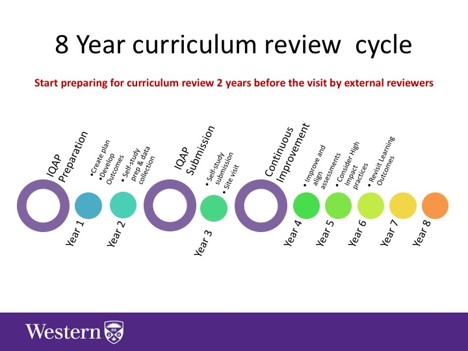
We recommend you begin preparing for curriculum review 2 years before the visit by external reviewers:
IQAP Preparation
Year 1: Create plan; develop outcomes
Year 2: Self-study prep & data collection
IQAP Submission
Year 3: Self-study submission; site visit
Continuous Improvement
Year 4: Improve and align
Year 5: Consider High impact practices
Year 6: Ongoing Improvement Progress Report
Year 7: Revisit Learning Outcomes
Year 8
How the CTL Supports IQAP
The Centre for Teaching and Learning assists in curriculum review and renewal processes that are faculty-driven, student-focused, collaborative, evidence-based, and meaningful to the needs of the department. The CTL provides support including facilitating various retreats and supporting the development of Program Learning Outcomes and Curriculum Mapping activities.
Curriculum Review
If you are creating a new program or if you need to re-envision your current program because of recent changes that have impacted the curriculum, please see:
Curriculum Planning for New Programs page
At Western, the IQAP process is overseen and supported by the Office of Academic Quality and Enhancement (OAQE) and by the School of Graduate and Postdoctoral Studies. For information about the process and timeline, please visit the OAQE website.
Ways in which the CTL supports programs during the self-study
- Provide feedback on retreat plans (selection of activities, timing, questions)
- Facilitate all or part of program curriculum retreats (optimally booked 2-3 months in advance of a scheduled retreat)
- Feedback on Program Learning Outcomes
- Support for curriculum mapping by providing templates and feedback
- Collecting Curriculum Data
Taking a scholarly approach to curriculum review
Think of curriculum review as an opportunity to collect data about the quality and outcomes of the curriculum and analyze it using the same research methods you may already use in your own research. Quantitative analysis of survey data or qualitative analysis of focus group and interview data provides material you may include in your self-study document; or use as the starting point for discussion about curriculum renewal at a faculty retreat. Types of data to support your self-study:
- surveys and focus groups about the strengths and weaknesses of the program (e.g., current students and alumni, employers, faculty, etc.)
- surveys about how alumni use what they learned in their careers
- student grades, sample work, and evidence of learning over time
- faculty-generated curriculum plans and vision
- curriculum maps that link learning outcomes with assessments and teaching methods
- Program-visioning retreats (e.g. CTL-led SOAR retreats)
- employment metrics of graduates, admission to graduate school, etc.
The Office of Academic Quality and Enhancement supports data collection. Please connect with them to learn more.
Resources and CTL Support
The CTL can provide:
- Guide: Conducting focus groups for curriculum review and improvement
- Strategies for gathering evidence of student achievement.
- Feedback on survey design, see also:
- survey template for undergraduate students or alumni
- example of undergraduate alumni online survey (Classics, Western)
- example of first year survey (History, Western)
- example of exit survey (History, Western)
Now What?
You will need to establish Program-level Learning Outcomes for your self-study. If you need to create new Program-level Learning Outcomes, or if you wish to revise your current Program-level Learning Outcomes, you can proceed to Program-level Learning Outcomes.
If your current Program Learning Outcomes do not require revision, you can proceed to Curriculum Mapping.