

Search Website
Universal Design for Learning
Universal Design for Learning (UDL) is a teaching and learning framework that supports the design of learning environments that are accessible to a broad range of learner needs. UDL embraces learner variability and strives to create spaces that allow learners to maintain and celebrate their unique identities rather than being assimilated into established norms (Hamraie, 2017).
UDL approaches inclusive learning design by acknowledging that barriers to learning are situated in the environment, not in the learner. When an environment, system or design doesn’t account for learner variability, learners may experience physical, infrastructural, attitudinal, technological, informational, or social barriers. Rigidly designed learning environments can reduce learner engagement, agency, and the ability to succeed. By proactively creating more flexible learning environments, instructors can reduce barriers for more learners from the outset, decreasing reliance on individualized, often time-consuming and stigmatizing, accommodations.
Learner Agency
UDL promotes learner agency, or the ability of learners to actively participate in and make choices about their learning experience in a way that honours their own goals, needs, and motivations. Learner agency can be both supported or constrained by learning designs and environments (Code, 2020). Through the application of UDL principles, learner agency is sustained by creating learning designs that are:
- Purposeful – by fostering interactions that inspire self-confidence and are meaningful to learners
- Reflective – by building learners self-awareness of both intrinsic and extrinsic motivations and influences on their learning
- Resourceful – by helping learners to understand and use the resources that are available to them, including their own strengths and capabilities
- Authentic – by increasing comprehension in ways that are relevant and impactful to real world situations
- Strategic – by supporting learners with goal-setting and progress tracking
- Action-oriented – by empowering learners to determine and take appropriate actions to support their learning goals
Designing learning environments that increase learner agency also means examining the relationships between instructors and learners and recognizing how assumptions, generalizations, prior experiences, or lack of information may impact learners’ ability to act.
The UDL Principles
UDL is built around three core principles: multiple means of representation, engagement, and action & expression. Each of these principles offers various guidelines and strategies for increasing flexibility, supporting learner agency, and fostering learning expertise. These guidelines should not be treated as a checklist, but as teaching strategies that can be adopted and adapted to specific learning contexts and situations (Dolmage, 2015). The goal of UDL is not to apply every guideline in every situation, but to identify which of the guidelines may have the greatest impact for a specific learning environment, learning goals, or group of learners.
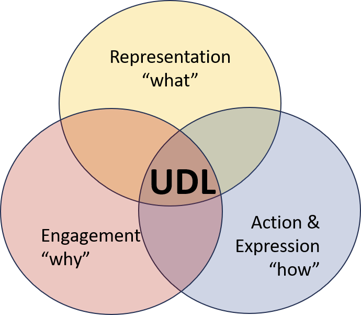
Caption: Fig. 1. The 3 core principles of Universal Design for Learning.
Multiple Means of Representation (the “what” of learning)
The multiple means of representation principle recognizes that learners differ in the ways that they perceive and make meaning from information. Applying this principle means ensuring that key information is perceptible and comprehensible to a wider range of learners: learners must be able to both access information and understand it.
Some key practices include:
- Presenting information in multiple formats (text, video, audio)
- Captioning videos and providing transcripts
- Providing Word Docs or PowerPoint Slides instead of PDFs
- Using clear language and providing definitions and explanations for complex concepts
- Supporting understanding across cultures, dialects, and languages by avoiding culturally specific references without explanation
- Providing opportunities for learners to apply concepts to new situation
For more details on Multiple Means of Representation, visit the corresponding module in the UDL OWL site.
Multiple Means of Engagement (the “why” of learning)
The multiple means of engagement principle recognizes that learners have different motivations, backgrounds, and identities that they bring to the learning environment. Applying this principle means giving learners opportunities to monitor their learning progress, identify their own learning goals, and make suitable choices to support learning.
Some key practices include:
- Choosing examples, content, or topics that represent a wide range of cultures, perspectives, and ways of knowing.
- Offering learners choice in the topics that they focus on in learning activities or assignments.
- Providing clear explanations of the purpose of different learning activities to help learners see how they align with learning goals.
- Providing detailed feedback throughout the learning process.
- Offering different ways of collaborating (e.g. individual work, pair work, groupwork) across the course and in a specific assignment
For more details on Multiple Means of Engagement, visit the corresponding module in the UDL OWL site.
Multiple Means of Action & Expression (the “how” of learning)
The multiple means of action & expression principle recognizes that learners navigate the learning environment and learning activities in different ways and may differ in how they demonstrate learning. Applying this principle means honouring this diversity by providing multiple pathways through the learning environment.
Some key practices include:
- Recognizing and supporting different forms of participation (e.g. speaking or writing).
- Designing materials to be compatible with assistive technologies (e.g. using headers appropriately or adding alt text to images).
- Inviting learners to complete assignments in different formats (writing, videos, audio, or other creative modality) when the format is not important to the learning outcome.
- Supporting student-led goal setting at key points in the course.
- Using graphic organizers to share key information.
For more details on Multiple Means of Action & Expression, visit the corresponding module in the UDL OWL site.
Want to learn more?
If you are interested in learning more about Universal Design for Learning, we run regular workshops focused on each of the principles. We also have a Certificate in Universal Design for Learning that provides an opportunity to apply the universal design principles to an existing course, learning materials, or learning environment.
References & Resources
CAST (2024). Universal Design for Learning Guidelines version 3.0. CAST. https://udlguidelines.cast.org
Centre for Teaching Support & Innovation (2026) UDL in Practice. University of Toronto. https://teaching.utoronto.ca/teaching-uoft-udl/udl-practice/
Code, J. (2020). Agency for Learning: Intention, Motivation, Self-Efficacy and Self-Regulation. Frontiers in Education (Lausanne) 5, https://doi.org/10.3389/feduc.2020.00019
Dolmage, J. (2015). Universal Design: Places to Start, Disability Studies Quarterly 35(2). https://doi.org/10.18061/dsq.v35i2.4632
Dolmage, J.T. (2017). Academic ableism: Disability and higher education. Ann Arbor, MI: University of Michigan Press.
Hamraie, A. (2017). Building Access: Universal Design and the Politics of Disability. University of Minnesota Press.
Kearney, D. (2022). Universal Design for Learning (UDL) for Inclusion, Diversity, Equity, and Accessibility (IDEA). eCampus Ontario. https://ecampusontario.pressbooks.pub/universaldesignvls/
La, H., Dyjur, P., & Bair, H. (2018). Universal design for learning in higher education. Taylor Institute for Teaching and Learning. Calgary: University of Calgary. https://taylorinstitute.ucalgary.ca/sites/default/files/UDL-guide_2018_05_04-final%20(1).pdf