

Search Website
Academic Consideration Policy
Flexibility in Assessment for Academic Consideration
What is flexibility in assessment?
By designing assessment frameworks with intentional flexibility, students can be better supported to demonstrate achievement of learning outcomes while not being unnecessarily impacted by personal extenuating circumstances. Flexibility can be built into both assignment deadlines and completion requirements. Each type of flexibility has its pros and cons; the best policy for your course depends on numerous contextual factors such as the needs of your students, number and types of assessments, course enrollment, and your workload. Finding the best policy for your course will take time (Hills & Peacock, 2022); however, many approaches to flexibility in assessment can be easily supported through OWL Brightspace.
What is the benefit for students?
Allowing flexibility in scheduling supports learner agency while recognizing that students have unique academic, personal, and professional circumstances. Furthermore, these circumstances can change quickly; students may not always be able to anticipate and plan for these circumstances. Providing flexibility allows for the unexpected and can reduce learner anxiety. It supports their engagement and motivation, as well as fostering equitable and inclusive learning environments (Hills & Peacock, 2022). When designing flexible assessments, it can be helpful to follow the Universal Design for Learning (UDL) principle of “teaching to the margins” by considering the support your students with the most access needs may require and designing the assessment to meet those needs.
What is the benefit for instructors?
Embedding flexible deadlines and completion requirements in your courses will help limit the number of individual interventions/adaptations you will have to make in response to academic consideration requests and allow students without formal accommodations to benefit from greater flexibility (CAST, n.d.). By deliberately designing flexibility, you can also ensure that key learning outcomes are still met by all students.
How do I implement flexibility in assessment?
Some examples of flexibility that would provide adequate support in lieu of academic consideration include:
- Flexible Deadlines: Flexible deadline policies allow you to take a proactive, student-centred approach to managing late assignments. Involving your students in conversations about deadlines and giving them some agency over their own schedules is one way you can enact the UDL strategy of providing options for self-regulation (CAST, n.d.).
Strategies
Establish an automatic extension for all assignments
- For example, “In this course, your written assignments have a 72-hour no late penalty. This means that you can submit any of these assignments up to 72 hours past the posted due date without penalty. Please be aware that requests for academic consideration for these assignments will be denied.”
- TIP: In OWL, it is possible to set a due date and an end date on assignments. If you set the end date to be later than the due date, students will be able to submit until the end date. Their submission will be marked as late.
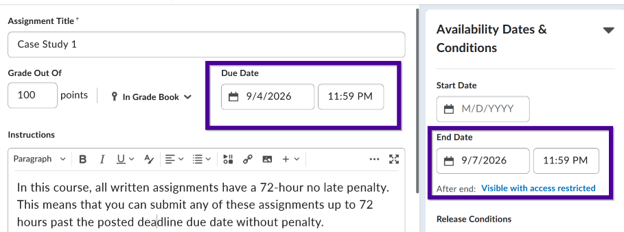
TIP: Don’t require students to provide notifications unless it is necessary for your planning. This reduces barriers for students and reduces your workload in tracking requests. If notification is required, consider using a tool like Qualtrics to systematically collect the information as opposed to asking students to email you with the information.
- Flexible Assignment Completion: Flexible completion options allows students to organize their time and provides opportunities for recovery from poor performance or missed assignments.
Strategies
Drop lowest grades in a series of assignments
- For example, “This course has weekly quizzes in weeks 2–11 for a total of 10 quizzes. The lowest 2 quiz grades, including missed quizzes, will be dropped from calculating your final overall grade for quizzes. Please be aware that requests for academic consideration for these assignments/quizzes will be denied.”
- TIP: In OWL, you can set up assignment categories to automatically drop a set number of assignments.
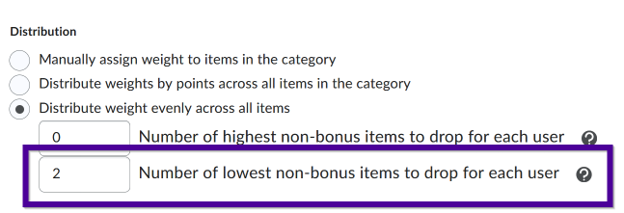
OWL Brightspace settings allow you to automatically set a certain number of assignments to drop. If you want to only mark 8 of 10 assignments, you can set it to drop the two lowest assignments.
Provide student choice in when to complete required tasks or assignments
- For example, “Every week, there will be ongoing discussion forums. You are expected to contribute to the discussions at least 5 times throughout the term. You may select the weeks that are of the most interest or that work best for your schedule. You are responsible for planning wisely. Please be aware that requests for academic consideration for these posts will be denied.”
- TIP: Talk to your students about the implications of skipping a contribution and how it could impact future unanticipated missed assessments. Encourage students to complete all assessments and coursework even if it might not be their best work at the time.
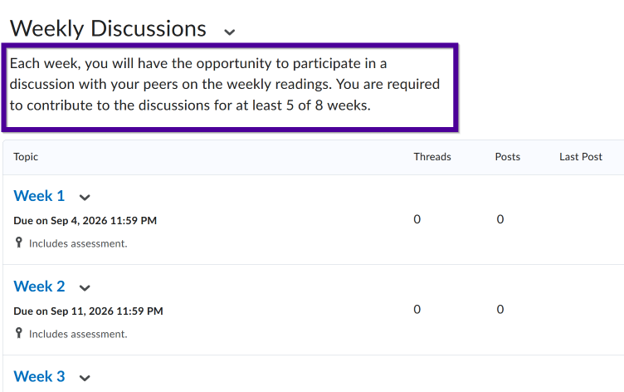
You can provide instructions for students to only contribute a certain number of times to a discussion forum. Marking can also be automated using the option to drop mentioned above.
Additional Resources
CAST (n.d.). UDL and assessment. UDL on campus: Universal Design for Learning in higher
education. http://udloncampus.cast.org/page/assessment_udl
Cook, A. (2001). Assessing the use of flexible assessment. Assessment & Evaluation in Higher
Education, 26(6), 539- 549. https://doi.org/10.1080/02602930120093878
Coyne, P., & Woodruff, S. J. (2022). Giving students choice: Does the use of a flexible assessment weighting scheme result in better student grades? International Journal of Teaching and Learning in Higher Education, 33(3), 398-406.
https://www.isetl.org/ijtlhe/pdf/IJTLHE4117.pdf
Hills, M., & Peacock, K. (2022). Replacing power with flexible structure: Implementing flexible deadlines to improve student learning experiences. Teaching and Learning Inquiry, 10.
https://doi.org/10.20343/teachlearninqu.10.26
Irwin, B., & Hepplestone, S. (2012). Examining increased flexibility in assessment formats. Assessment & Evaluation in Higher Education, 37(7), 773-785.
https://doi.org/10.1080/02602938.2011.573842
Jopp, R., & Cohen, J. (2022). Choose your own assessment–assessment choice for students in
online higher education. Teaching in Higher Education, 27(6), 738-755.
https://doi.org/10.1080/13562517.2020.1742680
Pacharn, P., Bay, D., & Felton, S. (2013). The impact of a flexible assessment system on students' motivation, performance and attitude. Accounting Education, 22(2), 147-167.
https://doi.org/10.1080/09639284.2013.765292
Schroeder, M., Makarenko, E., & Warren, K. (2019). Introducing a late bank in online graduate courses: The response of students. The Canadian Journal for the Scholarship of Teaching and Learning, 10(2). https://doi.org/10.5206/cjsotl-rcacea.2019.2.8200
Schwartz, M., Roach, N., Anwar, S., Tanner, J., & Thistle, R. (n.d.) Flexible learning resource. Toronto Metropolitan University. https://www.torontomu.ca/content/dam/learning-teaching/teaching-resources/teach-a-course/flexible-learning.pdf
Tobin, T. J., & Behling, K. T., (2018). Reach everyone, teach everyone: Universal design for
learning in higher education. West Virginia University Press.