

Search Website
Alternative Assessment
What is alternative assessment?
Traditional assessments in post-secondary education, such as exams or structured essays, often focus on measuring surface-level content knowledge. While well-designed traditional assessments can allow students to show deeper levels of application and evaluation of their learning, the typical structure of short, one-off occurrences of assessment encourage shorter-term learning and more limited retention for performance during exam windows. Traditional assessments can often require specific approaches or answers which are less accessible, and less flexible in allowing students to demonstrate their learning in diverse ways.
Alternative assessments, “refers to a variety of evaluation techniques that differ from traditional standardized testing methods, aiming to provide a more comprehensive and meaningful assessment of student learning... [and] prioritizes the demonstration of knowledge and skills in ways that closely mimic real-world tasks, engaging students in authentic and relevant contexts” (Merritt, 2019). Alternative assessments, encourage problem solving and iterative reflection and consideration over time, assessing students’ proficiency, rather than their ability to answer narrow questions. They are more open ended, and encourage students to decipher what skills and knowledge is needed for this situation and apply them, often without one correct answer. Such assessments might be authentic assessments, where students apply their learning to real world examples or environments, but might also be course specific applications which are more open ended. The below image from Elkhoury highlights the core principles of alternative assessments which we describe in more detail below:
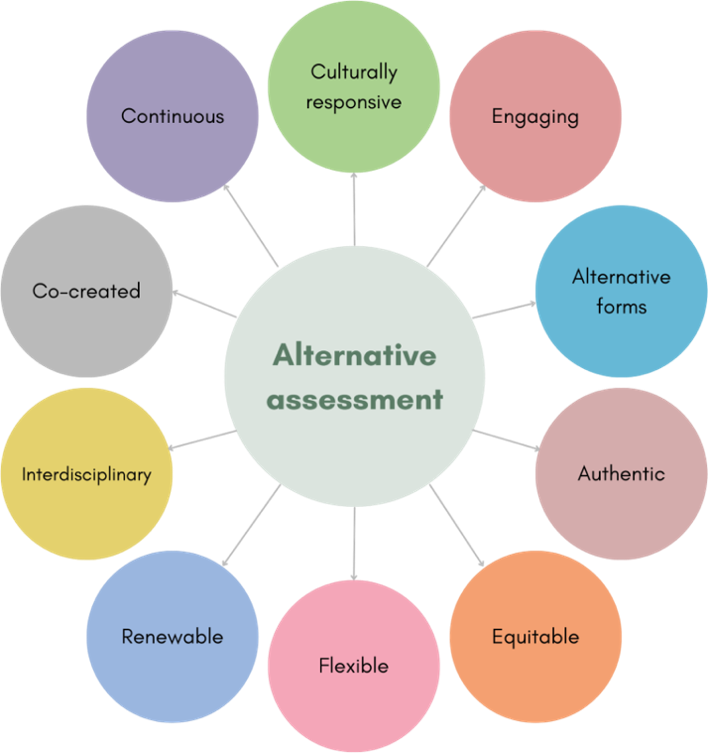
Fig. 1. Characteristics of alternative assessment. Eliana Elkhoury, “Ten principles of alternative assessment” in Learning Design Voices. CC BY 4.0 License.
- Alternative Forms - Alternative assessment uses a range of task types across modalities so students can show learning in diverse ways, rather than through a single standardized format. This variety helps capture skills and understanding that traditional exams often miss.
- Authentic - Assignments mirror the kinds of problems, products, or communication students may authentically encounter in the world. This makes assessment more meaningful and rooted in thoughtful and nuanced engagement with knowledge and communication.
- Equitable- These assessments are designed so that students with different ways of knowing, being, and communicating in the world have opportunities to succeed. They also proactively seek to remove barriers tied to more rigid testing structures.
- Flexible - Students have some choice in how, when, or where they demonstrate learning, allowing assessments to adapt to varied circumstances and needs. This flexibility respects different schedules, responsibilities, or access to resources, in alignment with the Universal Design for Learning framework.
- Renewable - Instead of “disposable” tasks that disappear after grading, these assessments create work that has enduring value and usefulness, including public-facing resources, and contributions to community organizations or social life
- Interdisciplinary - These assessments invite students to draw from multiple fields or perspectives, reflecting the complexity of real-world issues. They encourage integrated thinking rather than isolating skills into silos
- Co‑Created - In a Students-as-Partners approach, instructors and students can collaboratively shape assessment criteria, formats, or topics, which nurtures shared ownership of the learning process. This co‑design builds relationships and transparency and can strengthen motivation.
- Continuous - Assessment is ongoing rather than limited to a single high‑stakes moment. Students receive regular opportunities to show progress, revisit ideas, and refine their thinking and work throughout the course
- Culturally Responsive - Assignments honor and draw upon students’ diverse cultures, languages, community affiliations, and lived experiences. This makes assessment more inclusive and affirming for diverse learners.
- Engaging - Alternative assessments are intentionally designed to spark interest, curiosity, and active participation. They encourage deeper involvement by connecting learning to purpose and student agency
Why might you consider alternative assessments in your course?
Incorporating alternative assessments can have many benefits for learners and your classroom environment:
- When designing your course, alternative assessments can support universal design for learning principles by allowing multiple means of engagement and representation.
- Alternative assessments have also been shown to support more inclusive learning environments, allowing all students choice to achieve their own goals which leads to higher motivation.
- When such choice is designed into assessments, it can reposition learners as interpreters and creators of information and not simply recipients of knowledge. In doing so, more voices are encouraged in the assessment, and the opportunity is created for a wider, more inclusive understanding of what counts as knowledge (i.e. not just answers from the textbook), which can be part of a broader decolonizing approach.
In addition to learning gains in motivation and repositioning learnings, research has shown that alternative assessments can enhance metacognitive awareness and increase higher-order thinking. Especially when such assessments are scaffolded and taken as a collective across the course, alternative assessments can both support student learning and also serve as accurate reflections of student learning to meet assessment requirements.
Potential considerations when integrating alternative assessments
Just like any kind of assessment, ensuring alignment with your learning outcomes is an important first step. Determining what knowledge and skills you want students to be proficient in by the end of the course will allow you to choose assessments that measure these outcomes in meaningful ways.
Some students, especially those from more traditional educational backgrounds may also be hesitant towards alternative assessments. Offering a clear grading scheme, as well as clear structure for how students may, though are not required, to complete the assignment for those who need such structure can mitigate these concerns. Clarifying for students why you are integrating this approach by articulating why you are choosing this approach at the beginning of the course, talking about the barriers posed by traditional assessment types and bringing in campus partners (e.g., Writing Support Centre, Libraries) to support students engaging in alt assessment can also support successful integration
Especially in large classes, alternative assessments can be time consuming to develop and grade. Considering how such assessments may be designed to streamline grading through standardized rubrics and clear expectations can help mitigate this
Example alternative assessments
Below are a few example alternative assessments, as well as when you may consider using them in your course:
|
Assessment |
Description |
Use this assessment if you want students to… |
|
Problem based learning (PBL) |
Students are tasked with exploring solutions to a problem that derives from real-world situations with as authentic as possible real-world limitations and structures. PBL tasks are often more open-ended promoting student exploration |
-Practice concrete applications of theory and content. -Increase awareness of application and relevance of theory and discipline-specific knowledge |
|
Case based learning |
Students walk through a highly structured, well-defined, real-world example which applies and integrates class learning. Questions and guidance to direct students are provided at the beginning and throughout. |
-Apply theory to practice or real-world situations - Increase awareness of application and relevance of theory and discipline-specific knowledge |
|
Creative production |
Students demonstrate their learning through a non-traditional assignment format, such as creating a podcast or infographic. |
-Demonstrate learning in unique and diverse ways -Develop skills in creation |
|
Find the error |
Students receive calculations or problem-solving questions that have already been solved but contain an error or flaw. Ask students to identify (and possibly correct) the error. |
-Demonstrate their ability to find errors in sets of data, problem solving questions, or arguments |
|
Critical reflection |
Students explore their own, or another work’s assumptions/biases, strengths/weaknesses in relation to a course theme, articulating them in the form of an argument |
-Apply theory to practice or real-world situations -Explore alternative perspectives |
|
Concept maps |
Students create a visual representation of course material, showing relationships and connections between content across units or the entire course |
-Represent knowledge in graphic form -Organize, categorize and draw connections between material |
|
Learning portfolios |
Students collect evidence of their learning, including assignments, artifacts and reflections which demonstrate growth throughout the course |
-Reflect on their growth throughout the semester -Create an artifact showcasing instances of their learning |
For more examples of alternative assessments, you may want to check out York’s guide to alternative assessment.
Additional Resources
Angwaomaodoko, E. A. (2025). Alternative Assessment Methods in Higher Education: Evaluating their Impacts on Critical Thinking and Creativity. Traektoriâ Nauki, 11(08), 3022-3033.
Asaale, S. (2024). Ungrading as an Alternative Assessment Method in Higher Education: A Comprehensive Review and Analysis. Antistasis, 14(1), 158-166. https://www.lib.uwo.ca/cgi-bin/ezpauthn.cgi?url=https://www.proquest.com/trade-journals/ungrading-as-alternative-assessment-method-higher/docview/3201839110/se-2
Bourke, R. (2022). Normalising alternative assessment approaches for inclusion. In Assessment for inclusion in higher education (pp. 189-198). Routledge.
Centre for Teaching and Learning. (n.d.). Best practices in alternative assessments. Toronto Metropolitan University. https://ctl.uregina.ca/assets/bp-alternative-assessments-tmu.pdf
Elkhoury, E. (2020). A guide to alternative assessments. Teaching Commons, York University. https://www.yorku.ca/teachingcommons/wp-content/uploads/sites/38/2021/07/Guide_alternative_assessments-UPDATED-July-2021.pdf
Elkhoury, E. (2023). Ten principles of alternative assessment. In Jaffer, T., Govender, S., & Czerniewicz, L. (Eds.), Learning Design Voices (pp. 435-451). EdTech Books. https://doi.org/10.59668/279.12260
Godsell, S., Shabangu, B., & Primrose, G. (2024). Against colonial residues, towards decolonising assessment: a case study of a university history course. Cogent Education, 11(1). https://doi.org/10.1080/2331186X.2024.2362552
Janisch, C., Liu, X., & Akrofi, A. (2007). Implementing alternative assessment: Opportunities and obstacles. The Educational Forum, 71(3), 221–230. https://files.eric.ed.gov/fulltext/EJ763213.pdf
La, H., Dyjur, P., & Bair, H. (2018, May). Universal design for learning in higher education. Taylor Institute for Teaching and Learning, University of Calgary. https://taylorinstitute.ucalgary.ca/resources/universal-design-learning-higher-education
Merritt, R. D. (2019). Alternative assessment. EBSCO Research Starters. https://www.ebsco.com/research-starters/education/alternative-assessment
Williams, P. (2014). Squaring the circle: a new alternative to alternative-assessment. Teaching in Higher Education, 19(5), 565-577.