

Search Website
Program-Level Learning Outcomes (PLOs)
This page is designed to support you in writing or revising Program-level Learning Outcomes (PLOs). You may be engaging in this work as part of a formal program renewal or new program proposal (IQAP), accreditation requirements, or ongoing continuous improvement efforts. Regardless of the context, the goal is to ensure that program learning outcomes accurately reflect the most important learning that graduates should achieve by the end of the program.
The process outlined below provides a practical approach to developing and refining PLOs. To complete this work, you may find it helpful to revisit the goals of your program and access previous program review data, if available. To ensure that outcomes reflect shared expectations for graduate achievement, meaningful faculty engagement throughout the process is encouraged.
Writing Program-Level Learning Outcomes
Program-level learning outcomes are clear statements that describe the competencies that students should possess upon completion of a program (Anderson et al., 2001; Harden, 2002; Kennedy, 2007; Simon & Taylor, 2009). As part of the Institutional Quality Assurance Process, program-level learning outcomes are required for each Undergraduate module (e.g., Honors Specialization, Specialization, Major, Minor) and graduate program at Western. Drafting learning outcomes at the program level is a faculty-driven process and should be undertaken with opportunities for all faculty members to be involved.
The CTL supports the development of program-level learning outcomes in the following ways:
- facilitating workshops focused on articulating and revising program-level learning outcomes (e.g., the Program Learning Outcomes Retreat)
- incorporating equity, diversity, inclusion, decolonization, and accessibility values into program curricula and outcomes
- providing feedback on draft program-level learning outcomes
Effective learning outcomes state what students should know, value, and/or be able to do as well as articulate the depth of learning expected. Learning outcomes are often presented separately in the cognitive, psychomotor, and affective domains (Table 1), but may also reflect a range of interacting knowledge, skills and attitudes (Harden, 2002; Soulsby, 2009). Based on various situational factors and contexts, programs typically contain 6-12 broadly stated program learning outcomes that represent a graduate’s integrated and essential learning within the program.
Table 1: Domains of learning, with example levels of sophistication and common verb associationsa
|
Domain of Learning |
Levels of Sophistication |
Common Verb Associations b |
|
Cognitive (Knowledge) What will students know? |
remembering, understanding, applying, analysing, evaluating, creating |
define, identify, describe, differentiate, explain, apply, analyze, resolve, justify, recommend, judge, create, design |
|
Psychomotor (Skills) What will students be able to do? |
imitation, manipulation, precision, articulation, naturalization |
adapt, arrange, build, calibrate, construct, design, deliver, demonstrate, display, dissect, fix, mimic, operate, sketch, use, perform |
|
Affective (Attitudes, Values or Habits of Mind) What will students value or care about? |
receive, respond, value, organize, characterize |
ask, challenge, demonstrate, discuss, dispute, follow, justify, integrate, practice, judge, question, resolve, synthesize |
a see Marzano & Kendall (2007); Kennedy et al. (2007); Anderson et al. (2001); Bloom et. al. (1956; 1964) for further details and examples related to the domains of learning
b for more examples of action verbs at different levels of sophistication, view the Bloom’s Expanded Taxonomy of Learning and Krathwohl’s Affective Domain.
Drafting learning outcome statements
Learning outcomes are often written as a completion to the phrase, “By the end of this program, successful students will be able to…”). After this stem, choose an action verb that specifies the depth of learning expected, followed by a statement describing the knowledge, abilities, or attitudes to be demonstrated. Finish the outcome with a statement to provide context within the discipline.
By the end of this program, successful students will be able to…
|
action verb to identify the depth of learning expected (e.g., identify, explain, apply, analyze, evaluate, create). |
|
learning to be demonstrated statement specifying learning to be demonstrated (e.g., what?) |
|
learning context statement(s) to give the disciplinary context or state how the learning will be achieved (e.g., about what? why? how?). |
Learning outcomes should:
- Be concise, direct, and clearly stated. Terms such as understand, appreciate, and be aware of are vague and should therefore be avoided, and the specific level of achievement should be clearly identified.
- Be observable and measurable. Learning outcomes must be assessable, based on clearly defined criteria associated with the teaching/learning activities and assessment strategies contained within the curriculum. It is often helpful to add the preposition “by” or “through” followed by a statement that clearly states how the learning outcome will be assessed.
- Be balanced. If the learning outcome is too broad, it will be difficult to assess. If the learning outcome is too long and detailed, it will limit flexibility and adaptability in the curriculum.
- Be grounded within the discipline and consistent with disciplinary language, norms, and standards.
The CTL offers two supports to writing program learning outcomes:
- We offer Program Learning Outcomes Retreats (2.5-3 hours) where we facilitate the steps described below. Request a retreat by emailing curriculum@uwo.ca. We recommend this option if your program has experienced recent changes to the curriculum or you expect changes in the future.
- Use the guide below to develop or revise program learning outcomes without CTL facilitation. We recommend this option if your set of outcomes do not need a substantial revision. Feel free to book a consultation for support from our curriculum specialists at any stage by emailing curriculum@uwo.ca.
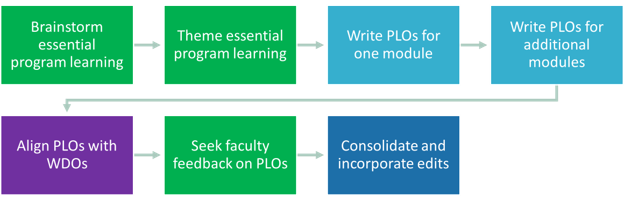
We recommend choosing a single module to begin your curriculum work, such as your default program or the one with the highest enrolment, like an Honors Specialization at the undergraduate level or PhD for graduate level Invite faculty members to provide their input on the top 5-10 knowledge, skills, and values that students should walk away with at the end of their program. You are encouraged to gather input from a wide range of community members, such as academic advisors, alumni, prospective employers, librarians, and faculty members from your program. We have developed a generic survey for you to send out to gather this information.
To download the survey file: Essential Program Learning for Program (QSF file) (right-click and click "Save link as"), and import the survey file into Qualtrics survey software. The survey requires editing before distributing to program or community members. Contact curriculum@uwo.ca for assistance if needed.
With your curriculum committee or as a group, sort survey responses into (ideally) 6 to 12 categories or themes. After you have created categories, create headings reflecting the theme of each category. These themes and accompanying items will form the basis of your new (or revised) program learning outcomes.
Watch the video for a demonstration of this theming process: Writing Program Outcomes Online - Theming Knowledge, Skills, and Values [6 minutes]
For each of your identified themes, use the survey data to generate draft learning outcome statements.
Use the brief tutorial below as well as the "Quick Guide to Writing Program Learning Outcomes (opens in new window)" which includes guidelines, example outcomes, and lists of action verbs
Video: Writing program learning outcomes online [9 minutes]
Consult Table 2 for “before and after” examples as suggestions for improving program-level learning outcomes.
Table 2. Examples of Improved Learning Outcomes
|
Before |
After |
|
Develop effective communication skills. |
Clearly communicate economic arguments in appropriate written, oral, and visual forms with the correct use of supporting evidence (including formulas, figures, and citations). |
|
Demonstrate personal and professional integrity. |
Critically reflect upon their own behaviours and actions as they relate to their personal ethics and the teaching profession. |
|
Understand scientific research. |
Critically evaluate and accurately explain scientific information, including original scientific research from primary literature. |
|
Critically analyze texts. |
Reference relevant cultural and historical information to analyze a literary text. |
Adapted from: Kenny (2013).
See Kennedy (2007) and Soulsby (2009) for additional details and examples related to writing effective course learning outcomes.
The complete list of outcomes for the module should describe the essential learning in that program. Put another way, if students completing the program walked away with only the outcomes you have written, would that be enough?
Collect the draft outcomes and share the complete list with your curriculum group, along with the Questions for Reviewing Program Learning Outcomes, below.
Questions for Reviewing Program Learning Outcomes
1. Do they accurately describe what a graduate should know, value and be able to do? Are there any specific statements that should be added, consolidated, or removed?
2. Do the learning outcomes align with those defined by the institution and/or other related programs?
3. Do the action verbs adequately convey an appropriate level of understanding for each learning outcome?
4. Could multiple audiences (e.g. students, instructors, employers, administrators, across institutions) understand the learning outcomes?
a. If not, how could the clarity of the learning outcome be improved?
5. Would the discipline be clear if the statement were read in isolation?
a. If not, what additional detail could be added to provide additional disciplinary context?
6. Could you appropriately assess each outcome?
a. If not, how should they be revised? What additional details/context is required
Questions when Decolonizing Learning Outcomes
Do the learning outcomes:
- Use an inclusive definition of knowledge
- e.g. knowledge is produced by human beings of all races, ethnicities, classes, genders, sexual orientations, and disabilities
- e.g. knowledge is a cumulative and shared resource, not owned by anyone
- Encourage students to question the discipline’s status quo
- e.g. consider the discipline in historic, local, and global contexts
- e.g. acknowledge existing power structures
- Centre diverse methods, theories, experiences, worldviews, and ways of being
- e.g. braid in Indigenous epistemologies, critical theories
- e.g. foreground gender, sexuality, intersectionality, race, colonization as they relate to the discipline
- Allow students to develop social-justice skills
- e.g. skills to navigate difficult conversations
- e.g. intercultural skills
- Leave space for inclusive, equitable, and accessible ways of teaching and assessing
- e.g. outcome verbs span cognitive, psychomotor, and affective domains
- e.g. allow students to share lived experiences and intersecting positionalities
- e. g. space for students to collaborate, build community both with each other and educators
Once you have program learning outcomes written for the initial module, you now need to write outcome statements for other modules in the program in a way that differentiates between the modules.
- For undergraduate programs, this includes Honours Specializations, Specializations, Majors, and Minors.
- For graduate programs, this includes Master's and Doctoral programs.
Differentiated program learning outcomes help reviewers answer the questions “why does Western offer these different modules? Why would a student choose one module over another?” The CTL offers a template Excel sheet to help with differentiating between modules.
Crafting separate learning outcomes for your unique modules can happen in more than one way. Some programs choose to change the complexity of their outcomes’ action verb while others will assign a specific learning outcome to some modules but not to others.
The table below illustrates how modules can be differentiated.
Example:
Citizenship Studies — Module Learning Outcomes
|
Honors Specialization in Citizenship Studies |
Major in Citizenship Studies |
|
Learning outcome A |
Learning outcome A |
|
Learning outcome B |
Learning outcome B |
|
Learning outcome C |
No equivalent |
|
Learning outcome D |
Learning outcome D |
|
Learning outcome E |
Learning outcome E |
|
Learning outcome F |
No equivalent |
|
Learning outcome G |
No equivalent |
In the example above, the two modules share some common learning outcomes (e.g. LOs A,B,D & E) while other outcomes have no equivalent. For outcomes that are shared across modules, we recommend differentiating between them through the level of sophistication expected from students.
In the example below, the achievement of Learning Outcome A at the Honors specialization level is more sophisticated (requiring the student to apply principles through a capstone project) than at the Major level:
Example
Learning Outcome A, Major in Citizenship Studies
Students will be able to describe the principles of ethical leadership and collaborative engagement to identify and explain how others have used these principles to advance and sustain local and global communities.
Learning Outcome A, Honors specialization in Citizenship Studies
Students will be able to apply the principles of ethical leadership and collaborative engagement to advance and sustain local and global communities through the completion of a capstone project.
What are Degree Outcomes?
As part of the curriculum review or new program proposal process, departments are asked to articulate how their students achieve the Western Degree Outcomes (WDOs) at the undergraduate level, and the Ontario Graduate Degree Level Expectations (GDLEs) or the Western Doctoral Learning Outcomes WDLOs) at the graduate level.
WDOs, GDLEs, and WDLOs capture the fundamental areas of knowledge and skills that Ontario students must acquire by the end of their degrees as set by the Ontario Council of Academic Vice-Presidents.
Watch our brief tutorial on how to align learning outcomes with Western Degree Outcomes (undergraduate level). Ensure that each Western Degree Outcome is covered by at least one outcome in each of your undergraduate modules.
Video: Aligning Program Learning Outcomes to Western Degree Outcomes [7 minutes]
If you have not already done so, send your updated program learning outcomes to the broader list of faculty members, instructors, and staff with a deadline for providing feedback. Some programs have also opted to seek feedback from students at this time. Share the Guiding Questions for Reviewing Program Learning Outcomes within your email. You can either:
- Share a OneDrive or Google Drive folder with each module,
OR
- Download a survey "Feedback on Program Learning Outcomes (QSF file)" (right-click and click "Save link as"), and import it (opens in new window) into Qualtrics. The survey requires editing before distributing to faculty members. Contact your CTL curriculum contact for assistance as needed.
Incorporate received edits into the program learning outcomes. If your curriculum work is in support of IQAP and cyclical program review, please ensure your finalized learning outcomes are ready in plenty of time to complete the curriculum mapping step.
Program-level Learning Outcomes Support
For further support with developing Program Learning Outcomes, the Centre for Teaching and Learning offers consultations and a Program Learning Outcomes Retreat (2.5-3 hours). Please contact a member of the CTL curriculum team to schedule a retreat.
Now What?
Once you have created Program-level Learning Outcomes, you can proceed to the Curriculum Mapping page.
Questions?
If you would like to discuss this topic further, please contact the CTL curriculum team.
References
Anderson, L.W., Krathwohl, D.R., Airasian, P.W., Cruikshank, K.A., Mayer, R.E., Pintrich, P.R., Raths, J., & Wittrock, M.C. (2001). A Taxonomy for learning, teaching and assessing: A revision of Bloom’s Taxonomy of Educational Objectives. Longman: New York.
Bloom, B.S., Engelhart, M.D., Furst, E.J., Hill, W. & Drathwohl, D. (1956). Taxonomy of educational objectives. Volume 1: The cognitive domain. MacKay: New York.
Bloom, B.S., Masia, B.B. & Krathwohl, D.R. (1964). Taxonomy of educational objectives. Volume II: The affective domain. MacKay: New York.
Harden, R.M. (2002). Learning outcomes and instructional objectives: is there a difference? Medical Teacher, 24(2), 151-155.
Hubball, H. T., & Burt, H. D. (2004) An integrated approach to developing and implementing learning-centred curricula. International Journal for Academic Development, 9(1), 51–65.
Hubball, H. T., & Burt, H. D. (2007) Learning outcomes and program-level evaluation in a four-year undergraduate pharmacy curriculum. American Journal of Pharmaceutical Education, 71(5): 90.
Hubball, H. T., & Gold, N. (2007). The Scholarship of curriculum practice and undergraduate program reform: theory practice integration. In D. Cox & L. Richlin (eds.), New directions for teaching and learning, no. 97. San Francisco: Jossey-Bass.
Kennedy, D. (2007). Writing and using learning outcomes: a practical guide. University College Cork: Cork, Ireland.
Kenny, N. (2013). Writing Course Learning Outcomes. Open Learning and Educational Support, University of Guelph.
Lizzio, A., Wilson, K., & Simons, R. (2002). University students' perceptions of the learning environment and academic outcomes: Implications for theory and practice. Studies in Higher Education, 27(1), 27-52. doi:10.1080/03075070120099359
Marzano, R.J. & Kendall, J.S. (2007). The New taxonomy of educational objectives. Corwin Press: Thousand Oaks, CA.
Simon, B., & Taylor, J. (2009). What is the value of course-specific learning goals? Journal of College Science Teaching, 39(2), 52-57.
Soulsby, E. (2009). How to write program objectives/outcomes. Accessed online at: http://www.assessment.uconn.edu/, Feb. 9, 2011.