

Search Website
Academic Integrity and Generative AI
If you would like to complete the corresponding activity with this webpage, please download the worksheet resource.
Academic integrity is the system of values that shapes the way the university community sets and maintains academic standards and upholds expectations of honesty and rigour in research and publishing. These values are also reflected in institutional policies on cheating and plagiarism.
With the rise of Generative AI (GenAI), a subset of AI which quickly generates new material based on material that it has been trained on, questions around how academic integrity can be supported and maintained have been met with new challenges that require instructor consideration and action to meaningfully uphold this culture. This requires us to update our approach to academic integrity to maintain fundamental values of the university. This resource will be of use to instructors teaching across Western’s campus in considering Academic Integrity in relation to GenAI.
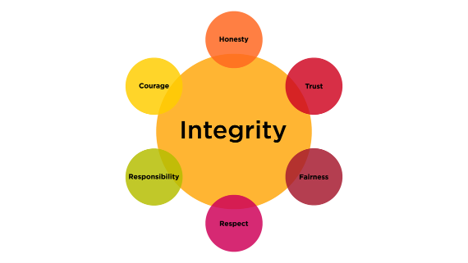
(ICAI, 2021)
The International Center for Academic Integrity defines academic integrity as according to six fundamental values: honesty, trust, fairness, respect, responsibility, and courage.
We provide further elaboration on each of these values below. Consider how these values can and should be enacted by both students and instructors, recognizing that they are a shared responsibility of all to achieve. Being explicit about these values, what they mean and your expectations for yourself and students in your class can support them being meaningfully integrated into your course.
- For an instructor this could look like clearly discussing when you have used GenAI in your own work
- For a student this could look like submitting work that reflects their own understanding, including references to external information and acknowledging when GenAI was used where appropriate
- For an instructor this could look like building assessments which focus on learning rather than GenAI surveillance
- For a student this could look like using GenAI tools responsibly and in-line with course expectations
- For an instructor this could look like recognizing that students may have different levels of access to and comfort with GenAI tools
- For a student this could look like considering where GenAI may provide some students with an unfair advantage
- For an instructor this could look recognizing different positions on GenAI adoption in your classroom
- For a student this could look like listening to peers and instructors who share different perspectives on GenAI integration
- For an instructor this could look like keeping current with evolving GenAI policies and best practices at your institution
- For a student this could look like critically evaluating and verifying GenAI-produced outputs
- For an instructor this could look like adapting your teaching practices in response to emerging technologies
- For a student this could look like resisting temptation to misuse GenAI
Academic Integrity Policies and Resources at Western
The Western University Secretariat provides policies and procedures on scholastic offenses related to academic integrity for students, defining things like plagiarism, cheating and the procedures for dealing with them. See the linked policies below.
Western’s Policy on Scholastic Offences
Western’s Undergraduate Procedures
A Statement on Academic Offences is a required component of all Western course syllabi. The template wording can be found in the Academic Handbook policy on Course Outlines.
Departmental Policies at Western
Faculties and departments act independently when it comes to general education and awareness of academic integrity issues. Many departments provide information beyond the definition outlined in the Academic Handbook in order to clarify guidelines within their discipline-specific context, and to ensure that undergraduate students have a firm understanding of academic misconduct. Some examples are provided below:
Department of Computer Science Policy on Scholastic Offences
Department of Modern Languages and Literatures Academic Policies
Department of Philosophy Website on Student Information
Faculty of Law Academic Policies and Procedures
Resources
Western Libraries provides helpful “how to” tutorials on citation styles/referencing and avoiding plagiarism.
The Writing Support Centre offers 1-hour writing seminars. The “Referencing Your Paper” presentation specifically focuses on citation and avoiding plagiarism.
Students can contact the Office of the Ombudsperson if they have been accused of a scholastic offence and want to speak to a neutral party in a confidential environment. The Office has published an information pamphlet for students.
All incoming students, both undergraduate and graduate, are required to complete an academic integrity module through Owl Brightspace early in their academic program. More information on these modules can be found on the Vice Provost (Academic Programs) website.
https://teaching.uwo.ca/teaching/assessing/academic-integrity.html#chatgpt
Strategies to Support Academic Integrity Generally and in Relation to Gen AI
With this understanding of academic integrity in mind, there are a few strategies you can use to foster a culture of academic integrity, mapped to the six Fundamental values above:
- Provide clear guidance on GenAI use: Creating a clear, course outline statement on GenAI use, including rationale is important. Students may not be familiar with the university’s Scholastic Offences Policy. As an instructor, you may want to increase awareness of course expectations by discussing these policies with students, and explaining the rationale behind them will support student understanding. (Responsibility, Trust – See for example the CTL’s Generative AI resources on this or the University of Saskatchewan Generative AI Resources)
- Have conversations with students about GenAI before it is used: Talking about the strengths and weaknesses of various learning approaches, including using GenAI, and how it will impact student success in your course. Students are often driven by curiosity when disruptive tools are introduced and if instructors don’t discuss implications for effective use, there may be opportunities for misuse of various strategies including GenAI. (Honesty, Trust, Respect, Courage)
- Discuss the connections between GenAI and Academic Integrity: Brainstorm implications of academic integrity and GenAI in education and beyond with students. Consider holding a discussion focused on academic integrity early in the term to highlight your expectations for student work. Discussion questions could include: What is plagiarism? What does it look like? Why is it wrong? When is it okay (and not okay) for students to collaborate on an assignment? (Courage, Respect, Trust – See for example this resource on having conversations with students about GenAI tools)
- Follow up with students suspected of GenAI misuse: Engage in one-on-one conversations with students suspected of academic misconduct including with GenAI use. If you provide expectations, be sure to consistently follow-up with students if the expectations are not met (Honesty, Trust, Respect, Responsibility – See for example this resource on having conversations with students about GenAI tools)
- Design AI-Aware Assessments: Develop tasks and assessments which consider various academic integrity challenges, including GenAI. In response to GenAI, you may want to either scaffold and incorporate GenAI, or rely more heavily on human engagement building in process visibility and considering tasks which are less easily delegated to GenAI (Fairness, Respect, Responsibility – See also CTL’s Generative AI resources on this or this article on the impact of Generative AI and Academic Integrity)
- Create conditions for student success in assessment: Balancing the demands of assignments and exams across several courses may be overwhelming for some students. Consider what you can do as an instructor to help students negotiate academic stress and to make good decisions in regards to academic integrity. Providing time estimates for assessments, and frequent reminders of upcoming deadlines, as well as assignment expectations (such as collaboration) can help students understand appropriate engagement with assignments.
- Model academic integrity for students: This includes being honest about your own use of GenAI. Model scholarship by citing your sources on lecture slides and in OWL, and be positive in supporting students but also be honest about the consequences of academic misconduct (Courage, Trust, Responsibility, Honesty, Respect, Fairness).
Based on the above, to come up with a plan, you may want to consider your biggest concern with regards to academic integrity and a strategy you might adopt in your class to support the maintenance of this principle.
If you need individual support in promoting academic integrity, feel free to reach out to us at ctl@uwo.ca.
Additional Resources
Centre for Teaching Excellence, University of Waterloo. (n.d.). Conversations with students about generative artificial intelligence (GenAI) tools. University of Waterloo. https://uwaterloo.ca/centre-for-teaching-excellence/catalogs/tip-sheets/conversations-students-about-generative-artificial
Centre for Teaching and Learning, Western University. (n.d.). Generative AI resources. Western University. https://teaching.uwo.ca/resources/generative-ai/index.html
International Center for Academic Integrity. (n.d.). Fundamental values of academic integrity. ICAI. https://academicintegrity.org/aws/ICAI/pt/sp/values
Kofinas, A. K., Tsay, C.-H., & Pike, D. (2025). The impact of generative AI on academic integrity of authentic assessments within a higher education context. British Journal of Educational Technology, 56, 2522–2549. https://doi.org/10.1111/bjet.13585
University of Saskatchewan. (2026, May). Generative artificial intelligence (GenAI). Academic Integrity. https://academic-integrity.usask.ca/gen-ai.php