The Unsettling Environmental Footprint of Artificial Intelligence and Some Options
Introduction
In 2024 a group of Scientists from the Institute for Artificial Intelligence Research and Development of Serbia made a presentation at the Institute for Electrical and Electronic Engineers International Conference on Smart and Sustainable Technologies, stating that: “The worst-case scenario, where LLMs are increasingly applied as general intelligence, showcases an exponential growth in energy consumption that could lead to a substantial increase in the global energy demand, potentially exacerbating environmental and social issues” (Bojic et al., 2024, p.3).
Startling scientific facts about AI’s problematic environmental issues
Until recently, there was scant literature about the water and electricity consumption of Artificial Intelligence. Below are some recent facts about the staggering impact that this technology will have on water and electricity resource demand, while subsequent sections in this challenge describe why this increased demand is problematic outside of a purely environmental lens.
Water use
- “The global AI demand is projected to account for 4.2– 6.6 billion cubic meters of water withdrawal in 2027, which is more than the total annual water withdrawal of four to six Demarks or half of the United Kingdom” (Li et al., 2025, p.1).
- “Working from calculations of annual use of water for cooling systems by Microsoft, the estimation is that a person who engages in a session of questions and answers with GPT-3 (roughly 10 to 50 responses) drives the consumption of a half-liter of fresh water” (Berreby, 2025).
- According to Google’s 2024 environmental report, two data centers in Council Bluffs, Iowa, sucked in 1.3 billion gallons of water from the local water supply. In 2024 the facility was expanded and that year the intake rose to 1.4 billion gallons (Google, 2024, p.79).
- Nathan Wangusi, a water scientist who, until last year, worked on sustainability issues for Amazon, has found that “there's a tendency to deny or cover up that water consumption exists” Mr. Wangusi thinks that this is an industry-wide problem (Montpetit, J.& Brend, Y., 2025).
Electricity use
- Experts from the Lawrence Berkeley National Laboratory estimate that “by 2028, AI will consume as much electricity annually as 22% of all US households” (O’Donnell and Crownhart, 2025).
- “Training one large ML model, such as Meena, is equivalent to 242,231 miles driven by an average passenger vehicle as far as carbon emissions” (Wu et al., 2022, p.2).
- Sam Altman , OpenAI chief executive, admitted at the January 2024 World Economic Forum’s annual meeting in Davos, Switzerland, that energy systems will struggle to cope with the next wave of generative AI systems. He is banking on nuclear fusion to help cope with this overwhelming demand. However, most experts agree that energy contributions by nuclear fusion won’t contribute significantly to the crucial goal of decarbonizing by mid-century to combat the climate crisis (Crawford, 2024, p.1). For example, Google's 2025 Environmental Report shows a 51% increase in carbon emissions in 2024 compared with 2019, despite its sustainability efforts outlined in the report (Cesaric, 2025).
- “AI’s power demand is so great, that Jeff Bezos, Amazon and Blue Origin founder, predicted in October 2025 that within 20 years, massive generating plants will be built in space, so they can harness the continuous solar power as they orbit earth” (Reguly, 2025).
- As local Governments and utility operators struggle to keep pace with the energy demands of AI, experts warn that these increased demands could lead to a “misallocation of resources, distracting from essential services such as healthcare, education and public welfare” (Bojic et al., 2024, p.2).
Figure 1.0 - The Power Draw of AI Data Centres
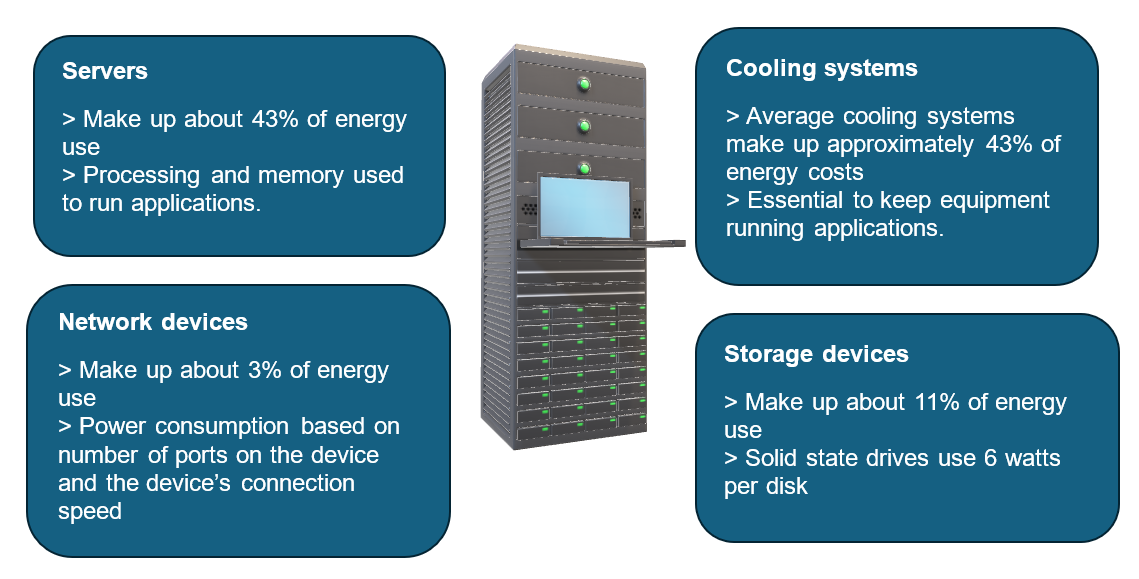
Source: (Masanet and Lei, 2020).
The supply and demand of inelastic goods
An alternate way to look at the environmental impact of AI is to use an economic perspective.
Basic principles of economics tell us that some goods and services are inelastic. This means that there are no substitutes for them and that they are an essential product that no matter the cost, society will have to continue to pay for. This is the case of water and electricity both of which are needed to fuel the operationalization of Artificial Intelligence through data centres.
For inelastic goods, the price will remain the same or go down as long as the supply increases with demand. However, when the demand for an inelastic good increases and the supply does not keep up, the price will increase significantly, and people will have no choice but to pay the increased costs (Thismatter.com Economics, 2021). This dilemma places hydro and utility companies in a position where they will need to keep up with water and electricity supply as AI demand increases to avoid costly bills for the general public (International Energy Agency, 2024, p.19). Recent research from Bloomberg found that at various locations in the United States the cost of wholesale electricity has increased by 267% over the last 5 years in areas close to data centres . It found that the price spikes affected the cost of electricity for households and businesses in those areas and also included fees to maintain and expand electrical networks (Saul et al., 2025).
The reality of electricity grids
The necessity to keep pace with electricity demand to avoid cost spikes means that utility companies will need to produce more electricity while being strapped by outdated grid systems and the upfront cost of these upgrades.
New data from the Canadian energy regulator shows that total electricity demand will increase by 47% from 2021 to 2050. Electricity makes up approximately 16% of Canada’s end-use energy demand, and under evolving policy scenarios, this is expected to raise to 30% by the end of 2050 (Canada Energy Regulator, 2025). Additionally, much of Canada’s capital infrastructure for the electricity system is near end of life and will need to be replaced or refurbished in the coming years (Canada Energy Regulator, 2025).
In their July 2025 technical paper- IESO Demand and Conservation Planning Technical Paper: Large Step Loads, the Independent Electricity System Operator (IESO) of Ontario show the increased strain on the grid system for the proposed project load of data center projects between 2025 and 2050 (see Figure 2.0). The increased electricity demand in megawatts is expected to increase from 100 MW to 1800 MW - an increase of 1700% (Independent Electricity System Operator, 2025b, p.11).
Figure 2.0 – Data centers in Ontario combined project load projections 2025 to 2050
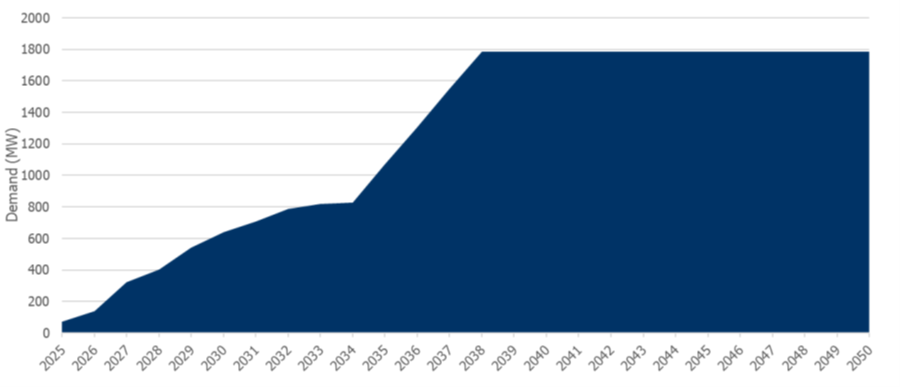
Source: (Independent Electricity System Operator, 2025b, p.11)
As local Governments and utility operators struggle to keep pace with the energy demands of AI, experts warn that these increased demands could lead to a “misallocation of resources, distracting from essential services such as healthcare, education and public welfare” (Bojic et al., 2024, p.2).
Options for sustainable AI deployment in Canada
The following section provides five possible solutions to help mitigate the environmental externalities of AI.
Track and regulate Power Usage Effectiveness (PUE)
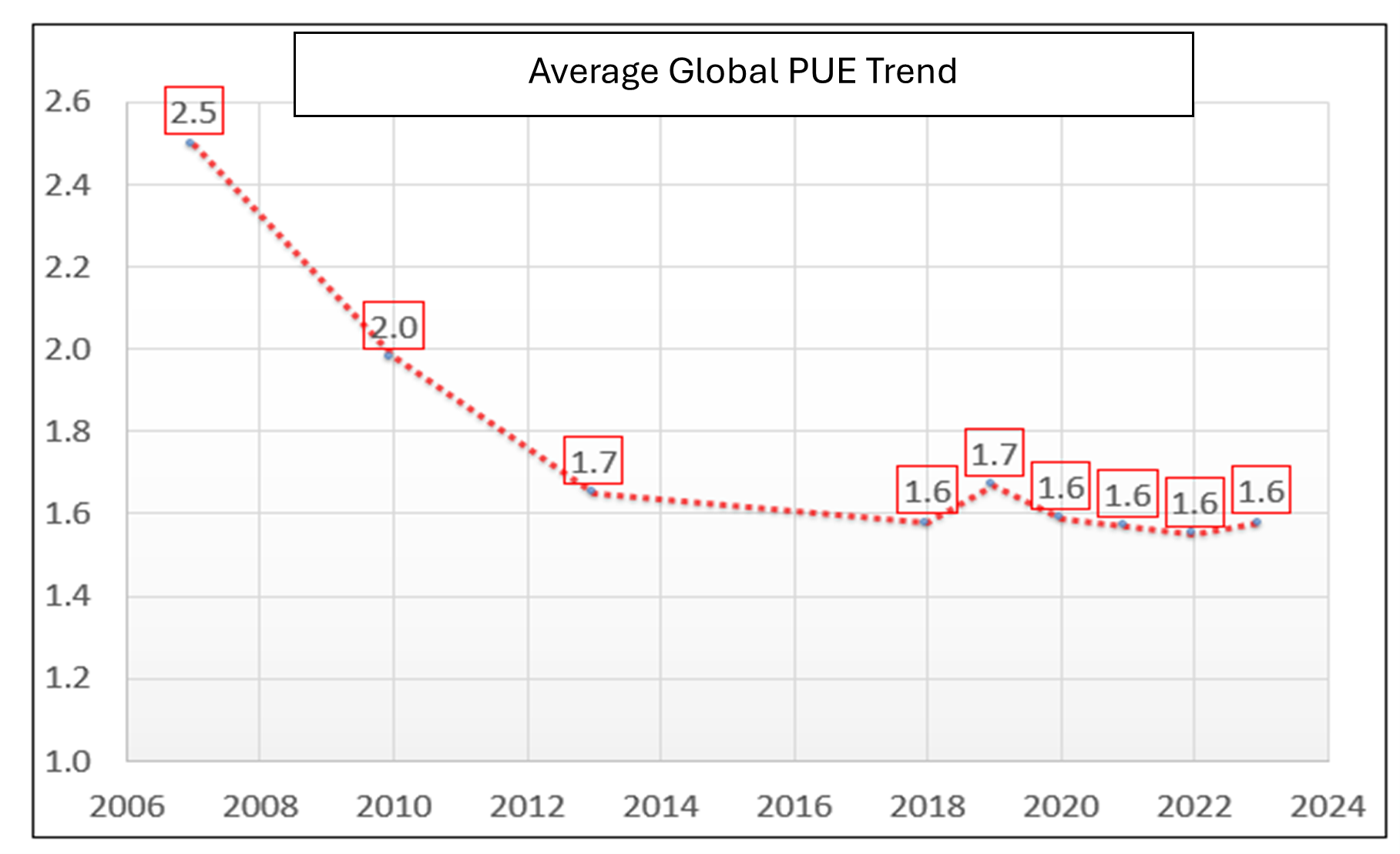
Tracking and regulating power usage effectiveness is a way to measure and mandate data centre energy efficiency. Power usage effectiveness (PUE) determines the energy efficiency of a data center, by determining the ratio of the amount of power entering a data center/ by the power used to run the IT equipment. Generally, over time the global PUE has decreased due to targeted approaches by Governments and technological breakthroughs in General Processing Units (GPUs) that have helped make data centres more energy efficient (the downward trend is good) – see Figure 3.0. In Germany, the current energy efficiency act mandates data centers in Germany to reduce their PUE from 1.5 to 1.3 between 2027 and 2030 (Independent Community Intelligence Services, 2024).
Figure 3.0 – Average Global Power Usage Effectiveness Trend
All data centre operators located in the European Union (EU) need to officially report energy and other resource use as part of the EU’s newly established General-Purpose AI Code of Practice (Kelly et al., 2025). The International Organization for Standardization says criteria for sustainable Artificial Intelligence to measure energy efficiency, raw material use, transportation, and water consumption, to assist consumers in making informed decisions about the AI consumption are coming shortly (Berreby, 2024). A 2023 Chemical Engineering Transactions paper suggests that the disclosure of the energy used by AI models is a step in the right direction to enable global environmental standardization for AI models (Szarmes and Élo, 2023, p.103).
To date, there has not been one single PUE estimate for Canada but Natural Resource Canada has put out the Best Practice Guide for Canadian Data Centres (2024).
Public AI infrastructure requirement for Ontario
The idea of a public AI infrastructure requirement is similar to the carbon tax but more realistic in that we can easily measure the amount of electricity and water being used by AI models and instead of small rebates being given back to the public, the infrastructure tax would be used directly to build sustainable energy sources for public infrastructure helping compensate for the excessive resources used by AI companies and their models.
Artificial Intelligence companies that use a baseline amount of energy and water to run their models would be required by law to pay into a public infrastructure fund administered by Provincial governments and local utility companies and used to pay for renewable energy infrastructure, such as solar panels, that contribute energy back to the public grid system. This assists in the dilemma provided above where the supply of electricity cannot keep pace with increased AI demand, and allows utility companies to keep prices static since they would be drawing on renewable energy sources for supply (deGomez and Noweir, 2024). This option is contrary to the Federal Government’s 2024 proposal in Powering Canada: A Blueprint for success where it is stated that, the financial burden of investment tax credits for clean electricity infrastructure will shift from ratepayers to taxpayers due to the societal-wide benefits of a clean energy transition (Natural Resources Canada, 2024).
Mandate data centre heat waste reuse
Scandinavia is often ahead of major environmental problems and there are already examples where data centres are powering homes with their wasted heat. In Finland, a 75-megawatt data centre close to the City of Mantsala heats 2500 nearby homes with the excess heat it produces. Currently Microsoft is building a cluster of data centers near Helsinki that with the help of a heat reuse model could supply heat to 40% of Espoo, Finland, a city about one hour from Mantsala (Paulson et al., 2025).
The European Union wants data centers to be connected to the surrounding district housing heating network to use the surplus heat. While the original version of the EU Energy Efficiency Directive stated that “new data centres larger than 1 MW need to perform a cost-benefit analysis for waste-heat recovery, including its use in district heating systems,” an amendment has been recently approved to include data centres larger than 100 kW, highlighting the potential that even small data centres have to contribute to Europe’s energy security through energy reuse (Kokkergard, 2022).
Recently the University of Waterloo, Ontario, Canada updated its major data centre on campus with enhanced computing power. As part of this process, the data centre now “harnesses leading-edge technology to reduce cooling costs and utilize water rather than air resulting in more efficient and sustainable systems for the future. Instead of paying to get rid of heat generated by high-performance computing, the heat is captured and repurposed to heat the Mike and Ophelia Lazaridis Quantum-Nano Centre” (University of Waterloo, Nibi website, 2025).
In their 2025 Report, the Independent Electricity System Operator of Ontario discusses that using waste heat from data centres is an energy efficient way to meet increased heating demand (Independent Electricity System Operator, 2025b, p.12).
Allow Artificial Intelligence to develop environmental efficiencies naturally
Optimists argue that there is potential for AI itself to “revolutionize energy use, energy grid management by contributing to the optimization of building design and controls, and helping to manage the complexity of increased supply and demand on grid systems” (Winston, 2025).
In July 2025, the Government of Canada made the following statement at the G7 summit in Kananaskis, Alberta. “We recognize that increased AI adoption will place growing pressure on our energy grids, produce negative externalities and have implications for energy security, resilience and affordability. At the same time, AI can be harnessed to promote energy innovation and bolster the resilience and reliability of our energy systems” indicating that the Federal Government believes the technology itself can solve its own environmental problems (Government of Canada, 2025).
The United Nations Environmental Programme discusses AI ‘s ability to detect data patterns, such as anomalies and similarities, as well as use historic knowledge to predict outcomes that could contribute to more planet-friendly choices (UN environment program, 2024).
An example where the technological trajectory includes environmental efficiencies is the memristor, or memory resistor. These are switches that can remember their previous electric state even after power is switched off reducing the time and energy needed for data transmission and allowing information to be recorded and read from the memristor by repeatedly applying an electric current (Feldman, 2024).
Actively discourage AI deployment and use
The new Microsoft data centres in Canada, which are slated to come online in the coming months, have faced no discernible opposition from the public. That’s in stark contrast to communities elsewhere in the world, where concerns about water scarcity have sparked protests (Montpetit & Brend, 2025).
In Clifton Township, Pennsylvania, a concerned resident, June Ejk set up a facebook page called Concerned Clifton Citizens, focusing on stopping a proposed 1.5GW data centre campus from coming to town. The 1,000 acres on which the centre is proposed covers two watersheds, a river and a brook, and the datacenter will potentially drain the water aquifers because of its correction damming for 34 new wells (Cesaric, 2025).
In Louisiana, the Alliance for Affordable Energy is calling Meta's Louisiana data center "a power-hungry giant" which also includes Entergy Louisiana's bid to build three gas plants to power it. The group cites expert testimony about a potentially debilitating strain on the electric grid and the cost to the citizens of Louisiana (Cesaric, 2025).
In Chile and Uruguay, planned data centers that would tap drinking water, have triggered protests (Berreby, 2024). These protests have resulted in some success. “In Uruguay, for example, Google changed the design of a new facility now under construction. It was initially due to be water cooled, but the US giant switched to an air-cooled system.” Google has halted plans for a data centre in Chile over similar water use concerns (Woollacott, 2024).
In Northern Virginia, environmentalists are opposed to the continuing expansion of the data centre sector in their region. Issues such as new electricity cables being built over conservation areas, parks and neighbourhoods, increased water demand, and air quality being affected by the facilities’ back-up diesel generators are cited reasons for the opposition. Additionally, it is reported that households in Virginia and neighbouring Maryland are “being expected to help pay for the data centres and electricity network upgrades” (Woollacott, 2024).
Considering the immense externalities that AI generates to society, as we have endeavored to highlight in this post, there seems to be a need for much more public awareness and local level decision making abilities around this issue.
Conclusion
This post has provided a high-level overview of some environmental impacts of Artificial Intelligence. It has also provided options to help deal with the resource consumption dilemma of Artificial Intelligence. The time to think holistically about the development and proliferation of Artificial Intelligence is now, so we are not shifting productivity gains in one sector to massive societal and environmental losses in others.
“Life on this planet is sustained by water. It is not sustained by data. We don't need data the way we need water, and we in Canada have been pretty blithe about our natural resources.” - concerned Nanaimo, B.C. resident (Montpetit & Brend, 2025).
Suggested reading
The atlas of AI: Power, politics, and the planetary costs of artificial intelligence. 2021, by Kate Crawford. This seminal book provides a great overview of the real systems behind AI and brings to light the huge amount of resources that go into its development.
The Challenge
Rank the options discussed above from best-to-worst in reducing the environmental impacts of AI. You can complete the poll here. We will post the results of this poll.
-
Track and regulate Power Usage Effectiveness (PUE) to encourage energy efficiency monitoring and enforce non-compliance of data centres
-
Implement a public infrastructure requirement for Ontario so that AI companies using a specific amount of power need to pay a tax to the Provincial government/Utility companies to be used for building renewable energy sources
-
Mandate energy re-use of new data centre heat waste towards sustainable computing
-
Allow Artificial Intelligence technology to progress naturally so that environmental efficiencies will develop over time
-
Actively discourage AI deployment and adoption to avoid further environmental impact
-
Other option (s) not discussed (open text paragraph)
References
-
Berreby, D. (2024, Feb 6). As Use of AI Soars, So Does the Energy and Water it Requires. Yale Environment 360. https://e360.yale.edu/features/artificial-intelligence-climate-energy-emissions
-
Bojic, L., Bala, K., Medojevic, M., & Talanov, M. (2024, June). AI and Energy Consumption: Social Aspects. In 2024 IEEE 9th International Conference on Smart and Sustainable Technologies (SpliTech) (pp. 1-4). https://doi.org/10.23919/SpliTech61897.2024.10612493
-
Canada Energy Regulator. (2025). Canada’s Energy Future. https://www.cer-rec.gc.ca/en/data-analysis/canada-energy-future/2021/key-findings.html
-
Cesaric, C. (2025). AI Data Centers Are Coming for Your Land, Water, and Power. CNET – Your Guide to a Better Future. https://www.cnet.com/tech/services-and-software/features/ai-data-centers-are-coming-for-your-land-water-and-power/
-
Crawford, K. (2024). Generative AI’s environmental costs are soaring — and mostly secret. Nature, 626, 8000 (pp 693). https://www.nature.com/articles/d41586-024-00478-x
-
de Gomez, W. and Noweir, B. (2024). The AI Public Infrastructure Requirement was presented as a novel idea at the 2024 Institute for Electrical and Electronic Engineers (IEEE) Youth Endeavors of Social Innovation Using Sustainable Technology Grand Finale in Science City, Tunisia. https://drive.google.com/file/d/1cWSfa8W5kB96z8AfZRMNSpootaHvVzjb/view?usp=drive_link
-
Feldman, A. (2024, Feb 22). New memristor design could be a game-changer for AI and big data. Advanced Science News. https://www.advancedsciencenews.com/new-memristor-design-could-be-a-game-changer-for-ai-and-big-data/
-
Google. (2025). Google AI Mode may become the default Google Search experience “soon.” https://searchengineland.com/google-ai-mode-may-become-the-default-google-search-experience-soon-461649
-
Google Environmental Report. (2024). https://www.gstatic.com/gumdrop/sustainability/google-2024-environmental-report.pdf
-
Google Environmental Report. (2025). https://www.gstatic.com/gumdrop/sustainability/google-2025-environmental-report.pdf
-
Government of Canada. (2025). G7 LEADERS’ STATEMENT ON AI FOR PROSPERITY. July https://g7.canada.ca/en/news-and-media/news/g7-leaders-statement-on-ai-for-prosperity/
-
Independent Community Intelligence Services. (2024). Data Centres: Hungry for power. https://uptimeinstitute.com/resources/research-and-reports/uptime-institute-global-data-center-survey-results-2024
-
Independent Electricity System Operator. (2025a). Annual Planning Outlook – Ontario’s electricity system needs: 2026-2030. https://www.ieso.ca/en/Sector-Participants/Planning-and-Forecasting/Annual-Planning-Outlook
-
Independent Electricity System Operator. (2025b). IESO Demand & Conservation Planning Technical Paper: Large Step Loads. https://www.ieso.ca/-/media/Files/IESO/Document-Library/planning-forecasts/demand-research/Demand-Conservation-Planning-Technical-Paper-Large-Step-Loads-202507.pdf
-
International Energy Agency. (2024). World Energy Outlook. https://www.iea.org/reports/world-energy-outlook-2024
-
Kelly, J. M. ,Witt, A. & Cunningham, J. (2025, July 11). The EU Commission Publishes General-Purpose AI Code of Practice: Compliance Obligations Begin August 2025. July 11. https://www.nelsonmullins.com/insights/alerts/privacy_and_data_security_alert/all/the-eu-commission-publishes-general-purpose-ai-code-of-practice-compliance-obligations-begin-august-2025
-
Kokkergard, H. (2022). Utilize waste heat from data centers in district heating. DTU. https://www.dtu.dk/english/news/all-news/nyhed?id=b2e4c8f0-0c62-437d-afbf-d2a17c376ffa
-
Li, P., Yang, J., Islam, M. A., & Ren, S. (2025). Making AI less' thirsty'. Communications of the ACM, 68 (7), 54-61.5. https://doi.org/10.1145/3724499
-
Masanet, E.& Nuoa, L. (2020). Energy Innovation. March 26. How much Energy Do Data Centers Really Use? https://energyinnovation.org/expert-voice/how-much-energy-do-data-centers-really-use/
-
Montpetit, J., & Brend, Y. (2025, Oct 18). AI-related data centres use vast amounts of water. But gauging how much is a murky business. CBC News · https://www.cbc.ca/news/ai-data-centre-canada-water-use-9.6939684
-
Natural Resources Canada. (2024). Powering Canada: A blueprint for success. https://natural-resources.canada.ca/energy-sources/powering-canada-blueprint-success#a25
-
O’Donnell, J and Crownhart, C. (2025, May 20). We did the math on AI’s energy footprint. Here’s the story you haven’t heard. MIT Technology Review. https://www.technologyreview.com/2025/05/20/1116327/ai-energy-usage-climate-footprint-big-tech/
-
Paulsson, L., Kari Lundgren and Kati Pohjanpalo. (2025). Power-Hungry Data Centre are Warming Homes in the Nordics. Bloomberg. May 14. https://www.bloomberg.com/news/features/2025-05-14/finland-s-data-centers-are-heating-cities-too
-
Reguly, E. (2025, October 11) Artificial Intelligence: The good, the bad and the ugly environmental costs. The Globe and Mail. B8 https://www.theglobeandmail.com/business/commentary/article-artificial-intelligence-good-bad-ugly-environmental-costs/
-
Saul, J., Nicoletti, L., Pogkas, D., Bass, D., and Malik, N. (2025, Sept 29). AI Data CEntrers are Sending Power Bills Soaring. https://www.bloomberg.com/graphics/2025-ai-data-centers-electricity-prices/?embedded-checkout=true
-
Szarmes, P., & Élo, G. (2023). Sustainability of Large AI Models: Balancing Environmental and Social Impact with Technology and Regulations. Chemical Engineering Transactions, 107, 103-108. https://doi.org/10.3303/CET23107018
-
Thismatter.com Economics. (2021). Supply Elasticity. https://thismatter.com/economics/supply-elasticity.htm
-
UN environment program. (2024, September 21). AI has an environmental problem. Here’s what the world can do about that. https://www.unep.org/news-and-stories/story/ai-has-environmental-problem-heres-what-world-can-do-about
-
University of Waterloo. (2025). Nibi website. https://uwaterloo.ca/research/meet-nibi
-
Winston, A. (2025). Will AI Help or Hurt Sustainability? Yes. MIT Sloan Management Review. April 10. https://sloanreview.mit.edu/article/will-ai-help-or-hurt-sustainability-yes/
-
Woollacott, E. (2024, November 3). The environmental campaigners fighting against data centres. BBC. https://www.bbc.com/news/articles/cz0mlrx0jxno
-
Wu, C. J., Raghavendra, R., Gupta, U., Acun, B., Ardalani, N., Maeng, K., & Hazelwood, K. (2022). Sustainable ai: Environmental implications, challenges and opportunities. Proceedings of machine learning and systems, 4, 795-813. https://doi.org/10.48550/arXiv.2111.00364
Disclosure
When searching for literature, the AI mode of Google was consciously skipped over and relevant articles were used in place of these summaries. Due to the lack of standardization around disclosure within software interfaces, it is impossible, and unfortunate, to say for certain that AI was not used on the back-end without end-user knowledge in default modes of Google Scholar search and other such programs (Google, 2025).
Your Challenger: Wendy de gomez

Wendy is a PhD student in the Department of Management Science and Engineering at the University of Waterloo where she researches the process of AI policy formation and its subsequent implementation by modelling both long and short-term externalities of AI development and deployment. Externalities include environmental impacts, political survival, organizational efficiencies, and interest group influence as variables affecting the development and proliferation of AI rules within rule-forming entities such as an organization or government. Wendy is a trained research strategist and data analyst with over 13 years of experience in the public and private sector and believes that a truly holistic perspective of this technology should be paramount in determining its acceleration path.