Strategic use of AI in Learning Science and Beyond
What is a balanced, reflective approach to learning science with generative AI?
Students from elementary to graduate school now have ready access to generative AI, and the way that we incorporate generative AI into our classrooms and conversations can help or hinder our students on their learning journeys.
Learning in Science
Science is about exploration and discovery, and finding out how our natural world works. These discoveries lead to theories and allow us to make useful and valuable technologies, predictions, and interventions, to ideally, make the world a better place. Students in science courses are exploring these discoveries and theories, and applying these laws and relationships to solve important problems. Learning in science is often perceived to be challenging. Chemistry, for example, involves understanding microscopic phenomena to explain macroscopic observations, often using symbols and mathematical principles (Talanquer, 2011), which is understandably challenging!
Even so, foundations in education reveal best practices and frameworks for teaching and learning that apply to science and beyond. Kolb’s experiential learning theory highlights the importance of having concrete experiences, reflecting on those experiences, conceptualizing and building connections from those experiences, and actively experimenting with those new understandings (Kolb, 2015; Kolb, D. A., 1984).
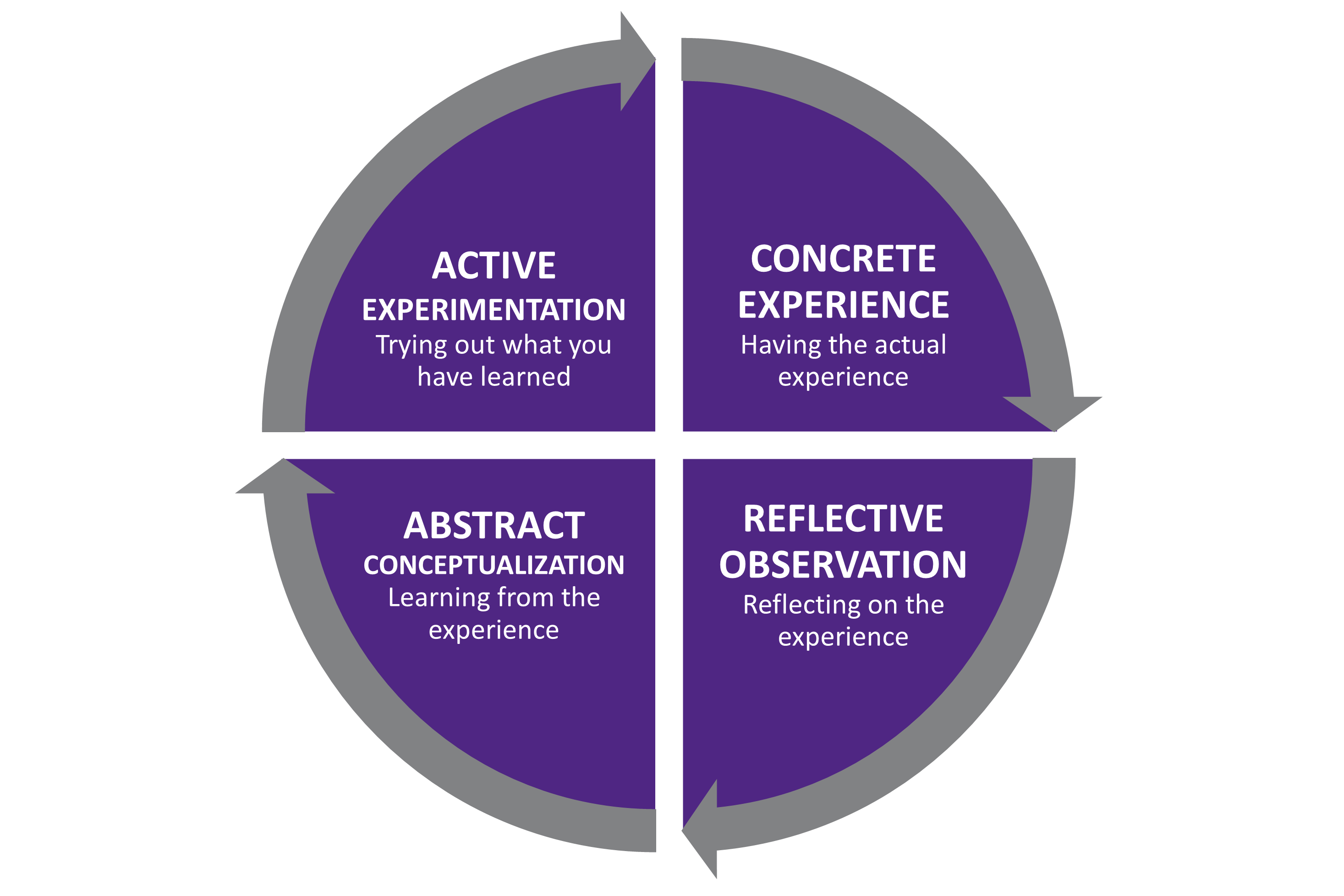
A recent meta-analysis with over 2000 participants in arts and sciences around the world has shown that reflective interventions in education have a significant overall effect on academic achievement (Zhai et al., 2023). Indeed, reflective thinking and critical thinking have been shown to positively and significantly predict university student achievement (Ghanizadeh, 2017).
Active learning in class, getting students engaged in the learning experience through thinking, comparing, connecting, discussing, and explaining, rather than passively receiving information, leads to stronger learning gains (Freeman et al., 2014). For example, prompting students to respond to questions facilitated through clickers in class and collaborate with peers strengthens learning (MacArthur & Jones, 2008). Reciting and reviewing content is more valuable than just reading content (McDaniel et al., 2009).
The Feynman technique is a popular study strategy for students that involves students explaining or teaching a concept in a simple way to themselves or others to improve their understanding of that idea (for a brief video on this technique, check out this link) Self-explanation research supports the principle behind the Feynman technique, showing that students learn better when they have to generate their own explanations of ideas, rather than just passively receiving explanations (Bisra et al., 2018; Chi et al., 1994).
Recent research is also revealing the importance of students’ perception of belonging in the classroom (Lawrie et al., 2025; Van Kessel et al., 2025). Sense of belonging has been linked to performance and persistence in chemistry classrooms (Fink et al., 2020), and interventions that promote a sense of belonging produce valuable academic gains (Walton et al., 2023; Walton & Cohen, 2011).
Given these frameworks and research into student learning, how can using generative AI in classrooms foster or hinder these learning ideals?
Learning Possibilities with AI
Imagine having a personal science tutor available 24 hours a day, 7 days a week. This tutor has more knowledge on any given topic, is great at problem solving, and can communicate ideas just the way that you understand! Could generative AI make this a reality?
Research on generative AI in education is revealing many exciting possibilities. For example, ChatGPT has been used to generate mathematical solutions in a research study with high school students and teachers, with ChatGPT-4o correctly solving 87% of mathematical practice problems (Ergene & Ergene, 2025). Students valued the clear explanations and immediate support afforded by ChatGPT and similar tools, and teachers agreed that the solutions were clear with valuable, step by step explanations. Many students are hesitant to approach their teachers with questions or are in massive classes that mitigate access to their teachers, so readily available, personalized support through generative AI is a valuable opportunity.
Business students using ChatGPT for case study analysis found this tool helped them to critically think about the case, consider new perspectives, brainstorm ideas, and, due to the possibility of AI generating false or nonsensical information (i.e. hallucinations), have a “heightened awareness” for fact-checking (Essien et al., 2024). The use of an AI feedback tutoring system on virtual medical training has been shown to be more effective than remote expert instruction, emphasizing specific goals and outcomes in its feedback to increase medical student performance, while also reducing instructor training time (Fazlollahi et al., 2022). Students are keen to use an AI chatbot assistant to help with course details and topics, provide real-world examples, respond to questions 24/7, and interact with them in a confidential way (Chen et al., 2023).
Students value immediate feedback, and research shows that informative feedback has a positive effect on student learning (Wisniewski et al., 2020). AI may be able to provide this immediate, informative feedback for students around the clock, potentially most impactful for those in high enrolment classes, or for those hesitant to approach an instructor with questions.
Using generative AI as a personal tool could be a transformative technology, allowing for redefinition of education, according to the Substitution, Augmentation, Modification and Redefinition (SAMR) framework (Ruben Puentedura, 2006).
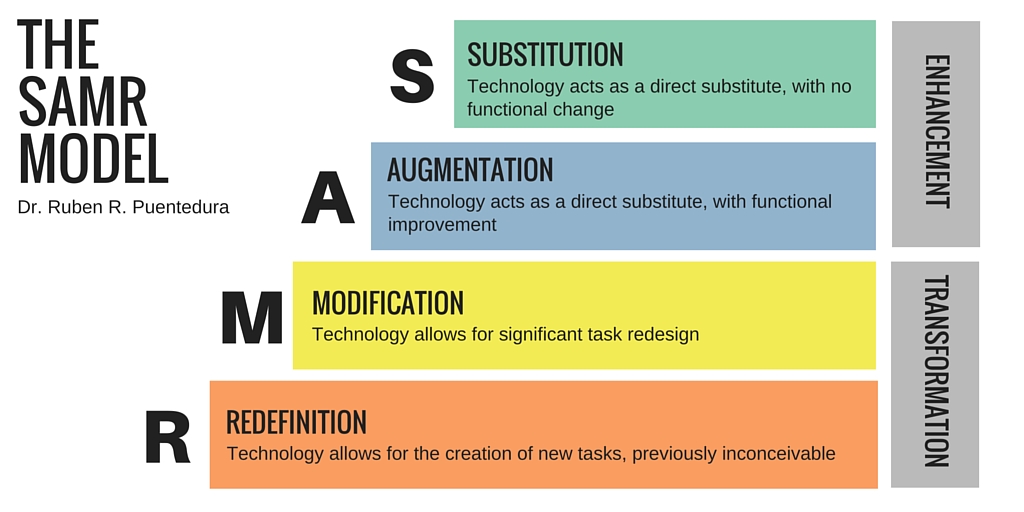
(Figure 2: SAMR Model framework (Ruben Puentedura, 2006) - (This file is licensed under the Creative Commons Attribution-Share Alike 4.0 International license.)
While this model provides a helpful way to classify the use of technology and perhaps prompt instructor imagination on how technology could transform learning opportunities, drawbacks for this model have been identified, such as its emphasis on the technology tool over the process of learning (Hamilton et al., 2016). Hamilton, Rosenberg, and Akcaoglu, discussing work by Higgins and Raskind (Higgins & Raskind, 2004), share a perceptive comment, that “the effects of technology use depend strongly on the nature of the teachers and students using it, as well as the specific task for which it is being used.” (Hamilton et al., 2016). Using novel technology is not the end goal. How and why it is being used are key.
Cautions and Concerns for Learning with AI
While generative AI opens many exciting possibilities, reliance on generative AI could move us to a dystopian learning era, where all students (and future society!) rely on external knowledge bases and are no longer capable of thinking, problem solving, explaining, or predicting on their own. (For a light-hearted view of an AI-reliant society, check out this link.)
Using AI tools can lead to passive engagement, rather than active engagement, and has been associated with lower critical thinking skills, mediated by cognitive offloading (Gerlich, 2025). If students rely on AI to think and solve problems for them, critical thinking, essential problem-solving skill development, and learning in general may not occur.
In addition, AI makes mistakes! Hallucinations, bias, and errors in explanations occur. Sole reliance on generative AI would be a dangerous. A recent review on ChatGPT in education revealed concerns about the quality and bias of responses, errors in responses, and risk of dependency on this technology (Ali et al., 2024). Indeed, in 2022, ChatGPT demonstrated poor accuracy (no higher than 37%) at answering chemistry exam problems (Leon & Vidhani, 2023) and in 2023, ChatGPT gave convincing, yet often incorrect, explanations for chemistry concepts (Yik & Dood, 2024). In a physics study, students were unable to distinguish between a correct solution for a high-difficulty problem and incorrect, incomplete, or misleading ChatGPT explanations (Dahlkemper et al., 2023). While current AI models are showing much stronger problem-solving capabilities, errors and omissions still occur.
Generative AI is also not human, and learning is a social endeavour (find a simple read on Social Constructivism here).
While aspects of interactive and collaborative learning could occur with AI, connecting with other people is a vital part of student learning and belonging. AI cannot replace interpersonal connections, role models, and learning in community, but it may be able to provide additional support to existing learning communities.
Strategic Use of AI
In one hand we hold the exciting possibilities of education being transformed by AI, and in the other we hold the awareness of the potential pitfalls of student learning being stifled by AI. Strategic, mindful, and reflective implementation of AI in education is a way forward.
Let’s take our understanding of experiential learning, active learning, reflective learning, and collaborative learning and explore how AI can support these processes. Every learning task in a course does not need to be (and should probably not be) transformed by AI, but for the cases where AI could augment, modify, and redefine learning, let’s explore! Your students are already using AI for learning, so how can you coach them to be active and reflective in the process?
-
Teach your students about how learning works (or as a student, take some time to learn about how learning works!). Based on learning theories and educational research, discuss how active learning, pausing and reflecting, and critically thinking are essential for real learning to occur. Apply these ideas to your course.
-
Emphasize the learning outcome for a given activity or lesson. What should students be able to do at the end of this learning? Then, discuss the difference between AI solving a problem and the student solving a problem; AI writing a thoughtful summary and the student crafting that summary. A helpful analogy shared by my colleague Dr. Mark Daley, is that you don’t go to the gym to watch someone else work out and expect to get stronger yourself. Offloading your thinking isn’t going to strengthen your learning, but if you need feedback, help identifying a misconception in a scientific theory, discussion about a misunderstanding in a problem-solving approach, or support identifying relevant resources, perhaps generative AI could support this learning process.
-
Reflect on your course and brainstorm how this powerful tool could strengthen your students’ learning experience (or your own learning). Do you have a high student-to-teacher ratio and field lots of questions? Could immediate, informative feedback with a GPT be helpful? Do you have a writing task where students could benefit from brainstorming ideas with a GPT? Do you want your students to practice predicting results for an experiment and have them receive feedback on their perspectives? Could your students benefit from making connections to additional, real-world applications of your course concepts or extra practice problems? Perhaps AI could make this happen.
For example, a chemistry student may need to solve a problem about the molecular shape of sulfur dioxide, SO2, a stinky gas produced from burning materials that contain sulfur. Simply identifying the shape “bent” would potentially answer the question but would be next to meaningless for this student’s learning development (i.e. memorizing all the shapes of all the molecules in the world would be painful and impossible!). Instead, this student needs to understand what theory governs how molecular shapes are determined, what factors about a molecule lead to its shape, and how to apply this concept to any given molecule. A GPT could guide this student through the relevant theory and problem-solving approach so that this student could independently solve a related problem in the future. If this student stopped at the answer “bent”, the learning process is moot. If this student simply read a GPT’s solution and moved on, this experience may also be moot (as passive reading is not necessarily an effective learning strategy!), but if this student interacted with the GPT to ask follow up questions, reflected on GPT’s responses, closed the GPT and tried self-explaining or explaining this theory to a friend, and then tried solving another problem independently to apply this concept (perhaps a new question composed by the GPT!), then real learning could occur.
Let’s coach our science students to move beyond using AI to give the “answer”, but to dig into explanations of theories, explore applications, consider analogies, discuss the how? why? when? of problem-solving approaches, and reflect on the learning. Then, close that generative AI tool and work independently to apply that knowledge and solve problems. Remind your students they need to reach those learning outcomes, solve problems independently on the test, discuss ideas clearly at future job interviews, and apply theories confidently in their future careers.
The way we engage with generative AI can help or hinder learning in science courses. Let’s be strategic in the way we coach students and ourselves to use generative AI.
The Challenge
Take 15 minutes this week to explore how generative AI could be used in your teaching or learning.
For instructors:
-
Consider the five most recent questions that your students asked you. Type those into your favourite GPT and reflect on the value and usefulness of the responses. (Consider also providing the GPT with some of your course materials/course outline, and try this again!)
-
Consider a topic you are teaching this week. Ask the GPT to give you an analogy or real-life example for that topic. For example, “How does heat capacity relate to real life? Why does heat capacity matter?”. Reflect on the value and usefulness of the response and consider sharing this in your class.
For students (and all learners!):
-
Consider a topic you are learning in one of your classes this week. Ask a GPT for an analogy or real-life example of this topic.
-
Consider a conceptual question you have from a class this week. Ask a GPT to explain this concept to you. Follow up with clarification prompts. Pause and reflect on how this response connects to what you already know and what outstanding concerns remain. Then close the AI tool and try explaining this concept aloud to yourself or a friend. Remember to double check the information against your official class materials (textbook, notes, etc.).
-
Consider a practice problem you found difficult this week. Explain your progress on this problem to a GPT and ask for a hint! OR ask a GPT for a strategy on how to solve this type of problem. Follow up with clarification prompts. Pause and reflect on how this response clarifies (or does not clarify) where you got stuck. Then close this tool and try solving this problem again on your own. Write down what you learned from this process that you can apply to solve similar problems in the future.
For everyone:
-
Think about a scientific topic that interests you, but that you know little about. Ask a GPT about this topic (For example: How does the flu shot work?) and specify who the audience is (a grade 9 science student, an arts professor, etc.). Ask follow-up clarification prompts. Ask for examples, analogies, or references to formal sources. Reflect on what you read: What did you learn? What are you still curious about? What aspect is still confusing? How would you explain this topic to someone at a future dinner party?
References
- Ali, D., Fatemi, Y., Boskabadi, E., Nikfar, M., Ugwuoke, J., & Ali, H. (2024). ChatGPT in Teaching and Learning: A Systematic Review. Education Sciences, 14(6), 643. https://doi.org/10.3390/educsci14060643
-
Bisra, K., Liu, Q., Nesbit, J. C., Salimi, F., & Winne, P. H. (2018). Inducing Self-Explanation: A Meta-Analysis. Educational Psychology Review, 30(3), 703–725. https://doi.org/10.1007/s10648-018-9434-x
-
Chen, Y., Jensen, S., Albert, L. J., Gupta, S., & Lee, T. (2023). Artificial Intelligence (AI) Student Assistants in the Classroom: Designing Chatbots to Support Student Success. Information Systems Frontiers, 25(1), 161–182. https://doi.org/10.1007/s10796-022-10291-4
-
Chi, M. T. H., De Leeuw, N., Chiu, M., & Lavancher, C. (1994). Eliciting Self‐Explanations Improves Understanding. Cognitive Science, 18(3), 439–477. https://doi.org/10.1207/s15516709cog1803_3
-
Dahlkemper, M. N., Lahme, S. Z., & Klein, P. (2023). How do physics students evaluate artificial intelligence responses on comprehension questions? A study on the perceived scientific accuracy and linguistic quality of ChatGPT. Physical Review Physics Education Research, 19(1), 010142. https://doi.org/10.1103/PhysRevPhysEducRes.19.010142
-
Ergene, O., & Ergene, B. C. (2025). AI ChatBots’ solutions to mathematical problems in interactive e-textbooks: Affordances and constraints from the eyes of students and teachers. Education and Information Technologies, 30(1), 509–545. https://doi.org/10.1007/s10639-024-13121-z
-
Essien, A., Bukoye, O. T., O’Dea, X., & Kremantzis, M. (2024). The influence of AI text generators on critical thinking skills in UK business schools. Studies in Higher Education, 49(5), 865–882. https://doi.org/10.1080/03075079.2024.2316881
-
Fazlollahi, A. M., Bakhaidar, M., Alsayegh, A., Yilmaz, R., Winkler-Schwartz, A., Mirchi, N., Langleben, I., Ledwos, N., Sabbagh, A. J., Bajunaid, K., Harley, J. M., & Del Maestro, R. F. (2022). Effect of Artificial Intelligence Tutoring vs Expert Instruction on Learning Simulated Surgical Skills Among Medical Students: A Randomized Clinical Trial. JAMA Network Open, 5(2), e2149008. https://doi.org/10.1001/jamanetworkopen.2021.49008
-
Fink, A., Frey, R. F., & Solomon, E. D. (2020). Belonging in general chemistry predicts first-year undergraduates’ performance and attrition. Chemistry Education Research and Practice, 21(4), 1042–1062. https://doi.org/10.1039/D0RP00053A
-
Freeman, S., Eddy, S. L., McDonough, M., Smith, M. K., Okoroafor, N., Jordt, H., & Wenderoth, M. P. (2014). Active learning increases student performance in science, engineering, and mathematics. Proceedings of the National Academy of Sciences, 111(23), 8410–8415. https://doi.org/10.1073/pnas.1319030111
-
Gerlich, M. (2025). AI Tools in Society: Impacts on Cognitive Offloading and the Future of Critical Thinking. Societies, 15(1), 6. https://doi.org/10.3390/soc15010006
-
Ghanizadeh, A. (2017). The interplay between reflective thinking, critical thinking, self-monitoring, and academic achievement in higher education. Higher Education, 74(1), 101–114. https://doi.org/10.1007/s10734-016-0031-y
-
Hamilton, E. R., Rosenberg, J. M., & Akcaoglu, M. (2016). The Substitution Augmentation Modification Redefinition (SAMR) Model: A Critical Review and Suggestions for its Use. TechTrends, 60(5), 433–441. https://doi.org/10.1007/s11528-016-0091-y
-
Higgins, E. L., & Raskind, M. H. (2004). The Compensatory Effectiveness of the Quicktionary Reading Pen II on the Reading Comprehension of Students with Learning Disabilities. Journal of Special Education Technology, 20(1), 31–40. https://doi.org/10.1177/016264340502000103
-
Kolb, D. A. (1984). Experiential learning: Experience as the source of learning and development. Prentice Hall.
-
Kolb, D. A. (2015). Experiential Learning: Experience as the Source of Learning and Development (Second Edition). Pearson Education, Inc.
-
Lawrie, S. I., Carter, D. B., Nylund-Gibson, K., & Kim, H. S. (2025). A tale of two belongings: Social and academic belonging differentially shape academic and psychological outcomes among university students. Frontiers in Psychology, 15, 1394588. https://doi.org/10.3389/fpsyg.2024.1394588
-
Leon, A. J., & Vidhani, D. (2023). ChatGPT Needs a Chemistry Tutor Too. Journal of Chemical Education, 100(10), 3859–3865. https://doi.org/10.1021/acs.jchemed.3c00288
-
MacArthur, J. R., & Jones, L. L. (2008). A review of literature reports of clickers applicable to college chemistry classrooms. Chem. Educ. Res. Pract., 9(3), 187–195. https://doi.org/10.1039/B812407H
-
McDaniel, M. A., Howard, D. C., & Einstein, G. O. (2009). The Read-Recite-Review Study Strategy: Effective and Portable. Psychological Science, 20(4), 516–522. https://doi.org/10.1111/j.1467-9280.2009.02325.x
-
Ruben Puentedura. (2006). Transformation, technology, and education [Blog post]. http://hippasus.com/resources/tte/
-
Talanquer, V. (2011). Macro, Submicro, and Symbolic: The many faces of the chemistry “triplet.” International Journal of Science Education, 33(2), 179–195. https://doi.org/10.1080/09500690903386435
-
Van Kessel, G., Ryan, C., Paras, L., Johnson, N., Zariff, R. Z., & Stallman, H. M. (2025). Relationship between university belonging and student outcomes: A systematic review and meta-analysis. The Australian Educational Researcher, 52(3), 2511–2534. https://doi.org/10.1007/s13384-025-00822-8
-
Walton, G. M., & Cohen, G. L. (2011). A Brief Social-Belonging Intervention Improves Academic and Health Outcomes of Minority Students. Science, 331(6023), 1447–1451. https://doi.org/10.1126/science.1198364
-
Walton, G. M., Murphy, M. C., Logel, C., Yeager, D. S., Goyer, J. P., Brady, S. T., Emerson, K. T. U., Paunesku, D., Fotuhi, O., Blodorn, A., Boucher, K. L., Carter, E. R., Gopalan, M., Henderson, A., Kroeper, K. M., Murdock-Perriera, L. A., Reeves, S. L., Ablorh, T. T., Ansari, S., … Krol, N. (2023). Where and with whom does a brief social-belonging intervention promote progress in college? Science, 380(6644), 499–505. https://doi.org/10.1126/science.ade4420
-
Wisniewski, B., Zierer, K., & Hattie, J. (2020). The Power of Feedback Revisited: A Meta-Analysis of Educational Feedback Research. Frontiers in Psychology, 10, 3087. https://doi.org/10.3389/fpsyg.2019.03087
-
Yik, B. J., & Dood, A. J. (2024). ChatGPT Convincingly Explains Organic Chemistry Reaction Mechanisms Slightly Inaccurately with High Levels of Explanation Sophistication. Journal of Chemical Education, 101(5), 1836–1846. https://doi.org/10.1021/acs.jchemed.4c00235
-
Zhai, N., Huang, Y., Ma, X., & Chen, J. (2023). Can reflective interventions improve students’ academic achievement? A meta-analysis. Thinking Skills and Creativity, 49, 101373. https://doi.org/10.1016/j.tsc.2023.101373
Disclosure
ChatGPT was used as a springboard to identify some relevant research articles for this discussion. Western Libraries databases were then used to directly investigate these articles. The scientific prompts suggested in this article were tested out on ChatGPT 5.2. The writing was done by Christina Booker with feedback from Dani Dilkes.
Your Challenger: Christina Booker
 Christina is a teaching scholar and assistant professor in the Department of Chemistry at Western University and teaches in the Integrated Science program. She serves as vice-chair of the Chemistry Education Division, Chemical Institute of Canada. She is passionate about engaging students in their learning, working to build problem-solving skills, and fostering a sense of belonging for students in science. Christina is exploring how AI tools can be used strategically to support student learning in large-enrolment courses. Hiking, biking, and reading with her family are some of Christina’s favourite activities.